
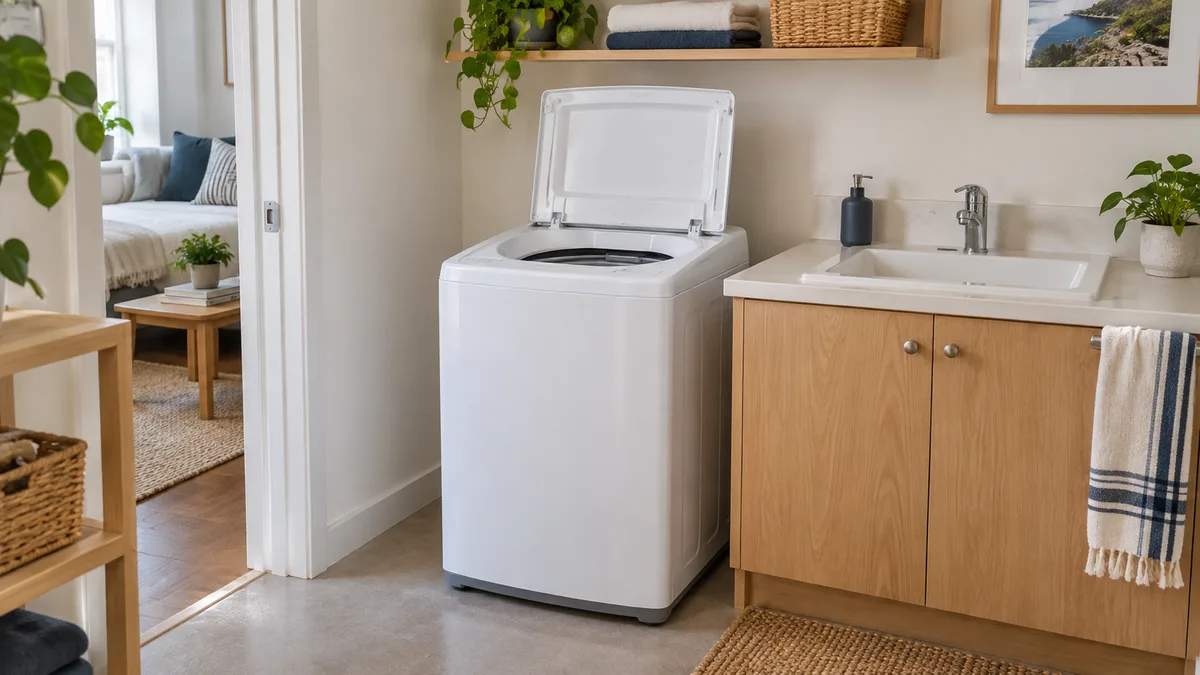
These washers solve different versions of the same problem. The BLACK+DECKER prioritizes a smaller cabinet; the COMFEE’ provides more drum volume. Both are automatic portable washers, so neither removes the need to plan water, drainage, power, and drying. Choose by the complete routine rather than the portable label.
The quick decision
Which would we choose?
Choose BLACK+DECKER for the tighter operating space; choose COMFEE’ for the larger listed load. If your connection or drain route is unresolved, settle that before picking either.
These are editorial selections from the models compared, based on manufacturer documentation. We have not hands-on tested them or measured performance, reliability, or noise. Confirm the exact model, installation instructions, seller, availability, and returns before purchase. “Best” refers to the use cases within this shortlist, rather than a market-wide ranking. Research checked October 18, 2026.
Compare the models at a glance
Product dimensions exclude operating clearances. Dimensions are in inches; W = width, D = depth, H = height, L = length. Unlabeled brand dimensions are kept in their published order.
| Model | Size | Format | Best fit | Current offer |
|---|---|---|---|---|
| BLACK+DECKER BPWM09W | 17.69 W × 18.06 D × 31.5 H in | 0.9 cu. ft. | a very small laundry spot | Check Amazon |
| COMFEE’ CLV16N2AMG | 20.3 W × 20.7 D × 36.6 H in | 1.6 cu. ft.; listed 11 lb load | fewer small-load sessions | Check Amazon |
Retailer links open a new tab. Search links are labeled “Search Amazon”; match the full model number. Check current price, availability, seller, and returns on the retailer page.
The shortlist
What each choice gives you
Best for a very small laundry spot
BLACK+DECKER BPWM09W
17.69 W × 18.06 D × 31.5 H in · 0.9 cu. ft.
A compact automatic option for someone who washes small loads often. Its narrower body is easier to accommodate than the larger washer here, making it a sensible starting point when floor space is the binding constraint.
Small loads mean more cycles. This cold-water model still needs an approved water connection, secure drain, and clearance above the top lid; it is not a water-free or hookup-free appliance.
Best for fewer small-load sessions
COMFEE’ CLV16N2AMG
20.3 W × 20.7 D × 36.6 H in · 1.6 cu. ft.; listed 11 lb load
The larger drum makes more sense when the smallest washer would force repeated sessions. Wheels and a delay-start feature are useful conveniences, although they do not remove the work of connecting, draining, and drying laundry.
It takes more floor space and is substantial to move. Confirm the exact model manual and seller dimensions: the current brand page lists 36.6 inches high, while older listings may differ.
Where the smaller cabinet earns its place
The BPWM09W makes the most sense when the extra width and depth of the COMFEE’ would obstruct an existing room function. Its advantage is tangible when it preserves a door path or creates a usable operating position beside a sink. Make a taped outline for each model instead of judging photographs. A few inches can determine whether you can stand beside the machine comfortably.
Where more capacity changes the routine
The COMFEE’ is worth the extra space if the smaller drum would repeatedly split your normal clothing load. More capacity can reduce the number of loading and draining sessions, but it does not establish washing quality, cycle duration, or long-term reliability. Compare the kind of clothing you wash rather than treating cubic feet as a universal people-per-household rating.
Moving and storing either machine
Picture the washer after the cycle: the hose is wet, the basket is full, and the machine may need to return to storage. Try the route with a cardboard footprint and measure thresholds. Neither model is a casual hand-carried travel appliance just because it is called portable. A storage plan is useful only if moving the machine remains manageable in everyday use.
The choice to make at checkout
Check the exact model number, included connection hardware, seller, return arrangements, and the manual supplied for that unit. Listings can round dimensions differently; our comparison follows the manufacturer sources linked below. If the available space is close to a listed limit, ask for the exact drawing instead of relying on rounding or assuming a hose can occupy no space.
Before you choose
Common questions
Does portable mean no hookup?
No. These automatic models need a water supply and a secure drain route. Temporary connection is different from having no connection.
Can either washer replace a dryer?
No. Spin extraction leaves laundry damp. Plan a suitable drying routine separately.
Sources and how we chose
We compared the exact models below using their brand specifications and setup information. Recommendations reflect our interpretation of those documents for small-space use. They do not represent hands-on testing, customer ratings, or a measured performance ranking.
- BLACK+DECKER BPWM09W: manufacturer specifications and support
- COMFEE’ CLV16N2AMG: manufacturer specifications and support
We omit live prices because offers change. No star ratings or review scores have been assigned. Read our full methodology.
Make the shortlist fit your room.
Measure the usable space, then add doors, drawers, hoses, and ventilation from the exact manual.
Open the fit check →