
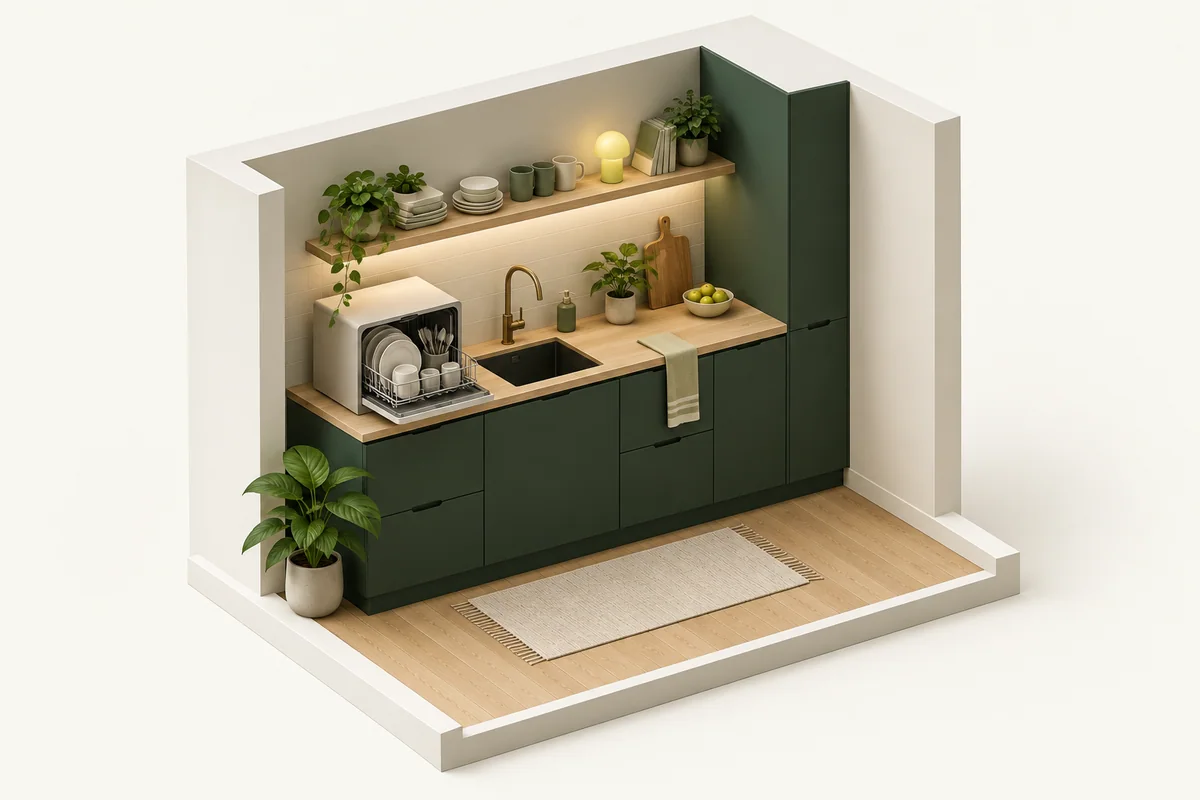
The water-supply method changes where a countertop dishwasher can sit, how much it can wash, and how much setup each load requires. Choose the connection first, then compare cabinet dimensions and wash programs.
The quick answer: A built-in tank changes how fresh water enters the dishwasher; it does not remove the need for drainage, power, supported counter space or door clearance. Choose a tank when the filling routine works; choose a faucet connection only when its compatibility is documented.
Plan these three things first.
A tank-fill model can be filled from a pitcher instead of attaching an inlet hose to the faucet.
02How a faucet-connected model worksA faucet-connected dishwasher uses a temporary inlet hose and quick-connect adapter during the cycle.
03Measure the complete water and drain pathRecord the distance from the intended counter position to the faucet, drain basin, and outlet.
How a built-in tank changes the setup
A tank-fill model can be filled from a pitcher instead of attaching an inlet hose to the faucet. That can help when the sink has a pull-down sprayer, hidden aerator, unusual thread, or no practical quick-connect fitting. The machine still needs a safe drain route, a grounded outlet, and enough room to fill the tank without spilling. Confirm the tank capacity and filling instructions for the exact model.
How a faucet-connected model works
A faucet-connected dishwasher uses a temporary inlet hose and quick-connect adapter during the cycle. This often supports a larger rack, but it temporarily occupies the faucet and depends on compatible threads, water pressure, hose reach, and a secure connection. Identify the faucet model and removable aerator before ordering. A listing that says an adapter is included does not prove that the adapter fits every sink.
Measure the complete water and drain path
Record the distance from the intended counter position to the faucet, drain basin, and outlet. Include hose bends, the open dishwasher door, cabinet trim, and the space needed to load dishes. The drain hose must reach a sink or manufacturer-approved drain point without crossing a walkway, kinking, or sitting where it can be knocked loose.
Compare rack capacity after choosing the connection
Tank-fill machines are often narrower and easier to place, but their rack may hold fewer place settings or smaller plates. Faucet-connected models are commonly wider and can handle more dishes per cycle. Check the maximum plate diameter, rack layout, and usable interior height instead of relying on a place-setting claim alone.
Choose around the routine you will repeat
A tank is usually the stronger fit when faucet compatibility is uncertain or the machine must sit away from the sink. A faucet connection can make sense when the adapter is confirmed and larger loads matter more than the temporary hookup. In either case, confirm building rules, supervise early cycles, and follow the product manual for filling, drainage, detergent, and storage.
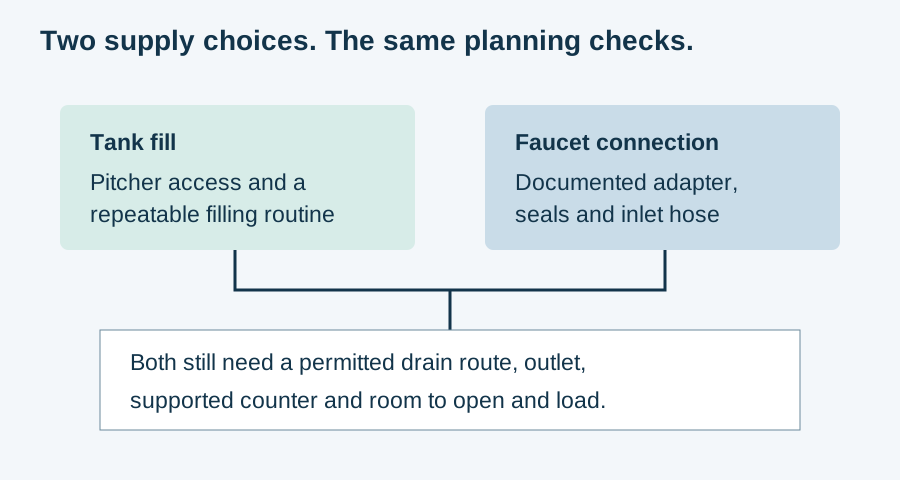
Make the decision concrete
Example: no faucet hookup still needs a drain plan
Imagine a free counter on the opposite side of the kitchen from the sink. A tank lets you carry fresh water to that position, but it does not establish a permitted drain route. Before buying, compare the exact manual’s hose routing and drain requirements with the room. If the only path crosses a walking route, choose another position or product. Separately test whether you can fill the tank and lower the door without moving a heavy appliance for every cycle.
| Check | Record | Watch for |
|---|---|---|
| Tank-fill option | Fill access and repeatable pitcher routine | Upper cabinets block the filling opening |
| Faucet option | Exact adapter and approved faucet connection | Pull-down sprayer assumed compatible |
| Both options: drain | Manual-approved route and secure endpoint | Hose crosses a walkway or can slip loose |
| Both options: loading | Supported feet, door travel and rack access | Counter fits body but blocks loading |
Try your measurements
Check one dimension at a time
Use the same direction for all three inputs: width, depth or height. Add all required extra space on that axis, including movement and manufacturer clearance. Repeat for the other axes and check obstructions separately.
Enter all three measurements. Leave required extra space blank if it is unknown; do not assume zero.
Available space − product body − required extra space = space remaining
Check the original instructions
COMFEE product support and user manualsFind documentation for your exact model before planning inlet, fill and drain connections. Model-specific installation limits are not inferred from the illustration. Support reference checked September 7, 2026.
See the measurements
Real products to compare with your space
These examples make the size tradeoffs easier to see. Open a product page for the complete fit verdict, setup notes, and retailer options.
HAVA R01
The smallest counters, RVs, and kitchens without a compatible faucet connection
View fit detailsFarberware FCD06ABBWHA
Households wanting a full six-place-setting countertop format
View fit detailsCOMFEE' WQP6-3602H-W
Value-focused shoppers who want more wash programs
View fit detailsDo this before placing the order.
- Measure the destination. Include the full usable width, depth, height, and every fixed obstruction.
- Measure the working position. Add door, lid, hose, ventilation, loading, and walking clearance.
- Measure the route. Check doors, halls, stairs, elevators, corners, and the storage opening.
- Verify the exact model. Compare the manufacturer documentation with the listing before buying.
What this guide cannot decide
This guide cannot verify a particular faucet thread, water pressure, drain capacity, electrical outlet, lease rule, or dishwasher connection without the relevant documentation.