
At-a-glance comparison
Compare six options by fit and setup
Start with exterior dimensions, operating clearance, access, and setup requirements. Then verify the exact model, current availability, and purchase terms at the retailer before ordering.
Affiliate disclosure: As an Amazon Associate, Small Space Buyer earns from qualifying purchases. This does not change the price you pay. Walmart links are included for comparison.
| Recommendation | Exterior size | Capacity | Setup | Retailer options |
|---|---|---|---|---|
| Shortest all-fridge pickMidea WHS-65LB1See fit details | 18.6 W × 17.7 D × 19.4 H in. | 1.6 cu. ft. | Reversible door; manual defrost | |
| Narrow freezer optionBLACK+DECKER BCRK17WSee fit details | 17.5 W × 18.5 D × 19.7 H in. | 1.7 cu. ft. | Small freezer compartment; reversible door | |
| Best narrow daily-use sizeMidea WHS-87LB1See fit details | 17.5 W × 20 D × 24.8 H in. | 2.4 cu. ft. | Freezer compartment; reversible door | |
| Balanced compact capacityBLACK+DECKER BCRK25VSee fit details | 17.5 W × 18.5 D × 26.6 H in. | 2.5 cu. ft. | Full-width freezer compartment; reversible door | |
| More room for meal prepGE GDE03GGKBBSee fit details | 18.75 W × 20.125 D × 33.375 H in. | 3.1 cu. ft. | Double door; reversible hinges | |
| Largest small-space optionDanby DAR044A4BDDSee fit details | 20.71 W × 20.87 D × 32.8 H in. | 4.4 cu. ft. | All-refrigerator layout; reversible door |
Decision gate
Can the refrigerator breathe and open fully?
A compact refrigerator can fit the opening and still fail the room. Ventilation, door swing, hinge space, leveling, outlet access, and shelf removal matter as much as the cabinet dimensions.
Use these checks to narrow the list, then open the exact specification and retailer listing for the model you are considering.
 #1 · Shortest all-fridge pick
Midea · WHS-65LB1
Midea WHS-65LB1 1.6 Cu. Ft. Compact Single-Door Refrigerator with Reversible Door
Best for: Drinks and snacks when vertical space is extremely limited
- Exterior size
- 18.6 W × 17.7 D × 19.4 H in.
- Capacity
- 1.6 cu. ft.
- Cooling
- Energy Star
- Placement
- Reversible door; manual defrost
#2 · Narrow freezer optionBLACK+DECKER · BCRK17W
BLACK+DECKER BCRK17W 1.7 Cu. Ft. Energy Star Mini Refrigerator with Freezer Compartment
Best for: The narrowest refrigerator footprint in this department
- Exterior size
- 17.5 W × 18.5 D × 19.7 H in.
- Capacity
- 1.7 cu. ft.
- Cooling
- Energy Star
- Placement
- Small freezer compartment; reversible door
#3 · Best narrow daily-use sizeMidea · WHS-87LB1
Midea WHS-87LB1 2.4 Cu. Ft. Compact Refrigerator with Large Door Rack and Freezer Compartment
Best for: One-person daily food storage in a narrow footprint
- Exterior size
- 17.5 W × 20 D × 24.8 H in.
- Capacity
- 2.4 cu. ft.
- Cooling
- Energy Star
- Placement
- Freezer compartment; reversible door
#4 · Balanced compact capacityBLACK+DECKER · BCRK25V
BLACK+DECKER BCRK25V 2.5 Cu. Ft. Energy Star Compact Refrigerator with Freezer
Best for: More usable storage without growing beyond 17.5 inches wide
- Exterior size
- 17.5 W × 18.5 D × 26.6 H in.
- Capacity
- 2.5 cu. ft.
- Cooling
- Energy Star
- Placement
- Full-width freezer compartment; reversible door
#5 · More room for meal prepGE · GDE03GGKBB
GE GDE03GGKBB 3.1 Cu. Ft. Energy Star Double-Door Compact Refrigerator with Separate Freezer
Best for: Shoppers who need a true separate freezer in a compact width
- Exterior size
- 18.75 W × 20.125 D × 33.375 H in.
- Capacity
- 3.1 cu. ft.
- Cooling
- Separate 0.93 cu. ft. freezer
- Placement
- Double door; reversible hinges
#6 · Largest small-space optionDanby · DAR044A4BDD
Danby DAR044A4BDD 4.4 Cu. Ft. Designer Compact All-Refrigerator with Automatic Defrost
Best for: Maximum fresh-food and drink storage without sacrificing space to a freezer
- Exterior size
- 20.71 W × 20.87 D × 32.8 H in.
- Capacity
- 4.4 cu. ft.
- Cooling
- Automatic defrost
- Placement
- All-refrigerator layout; reversible door
Affiliate disclosure: As an Amazon Associate, Small Space Buyer earns from qualifying purchases. This does not change the price you pay. Walmart links are included for comparison and may become affiliate links after program approval.
Check the space needed in use
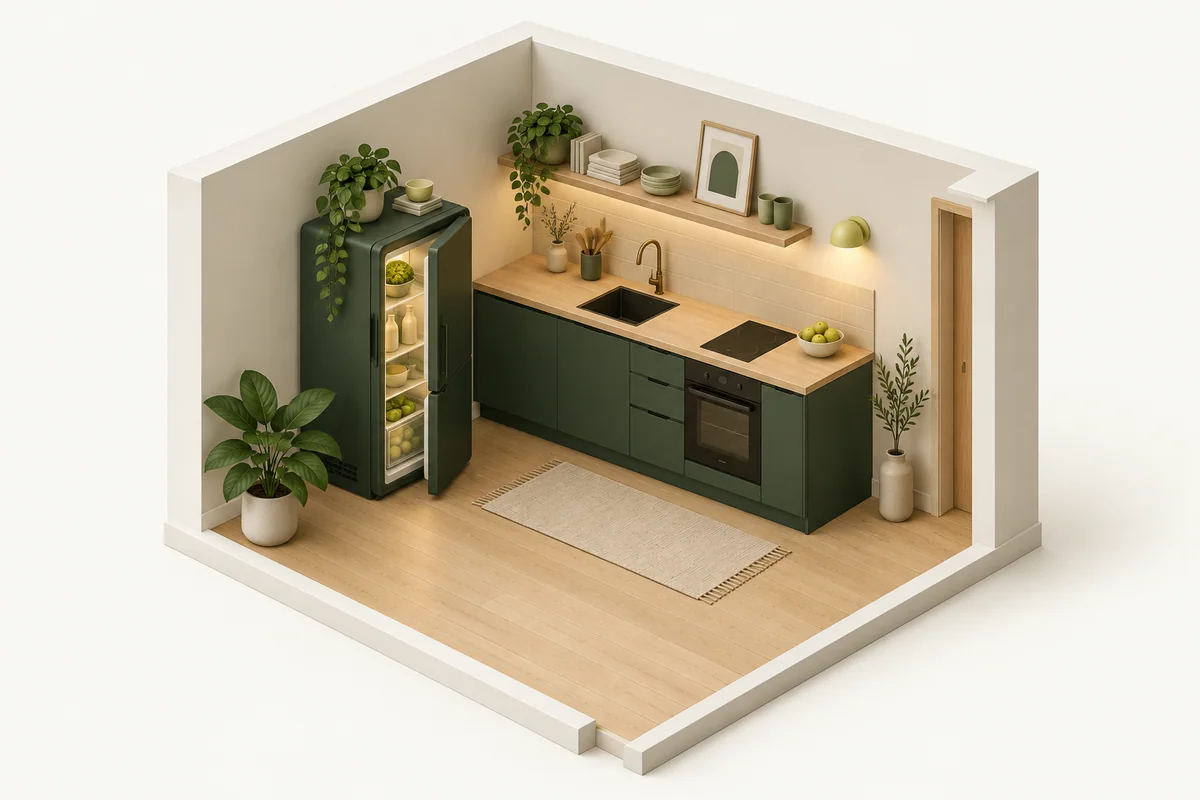
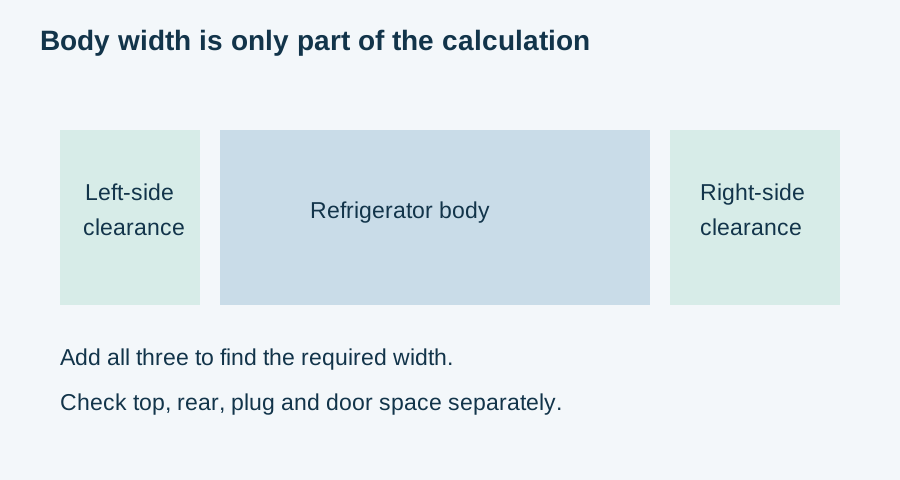
Check the model’s installation type before measuring the opening. Add its required side, rear and top ventilation spaces to the cabinet dimensions, then test door movement and shelf removal separately. A cabinet-size match is not installation approval.
Fit guidance
How to choose for a genuinely small space
Ventilation space is part of the fit
Refrigerators release heat around the cabinet and need the clearances stated by the manufacturer. Do not choose from width, depth, and height alone. A unit that physically slides into a tight cubby may still be unsuitable if warm air cannot escape.
Door swing can make a good measurement useless
Confirm that the door can open far enough to remove shelves and use drawers. A reversible door helps in awkward corners, but the hinge still needs side clearance and the handle or door edge may extend beyond the cabinet.
Pick the right kind of cold storage
Very small single-door models are practical for drinks and snacks. A freezer compartment adds flexibility but reduces fresh-food space and usually requires manual defrosting. For regular groceries or meal prep, prioritize usable shelving and capacity over the shortest cabinet.
Plan the complete setup
Read the guides that answer the next question.
These guides cover exact size limits, measurements, connections, and operating clearances that product listings often leave unclear.
Exact-dimension shortlist
Mini Fridges 20 Inches Wide or Less
Compare compact refrigerators 20 inches wide or less by depth, height, capacity, freezer layout, door swing, and ventilation.
See qualifying products Buying guideVentilation and door clearance
Add airflow, hinge, plug, and open-door space to the cabinet measurements.
Read the guide Buying guideMeasure any small space
Check the opening, operating footprint, and complete delivery path.
Read the guide Buying guideDorm appliance and storage checklist
Check housing rules, ventilation, outlets, and shared-room fit.
Read the guideCommon questions
Best Compact Refrigerators for Small Spaces: FAQ
Can a compact refrigerator go inside a cabinet?
Only if the installation follows the manufacturer's ventilation and clearance requirements. Freestanding models should not be tightly enclosed.
Do mini fridges need a dedicated outlet?
Follow the appliance manual and local electrical requirements. In general, use a properly grounded outlet and avoid extension cords unless the manufacturer explicitly allows one.
Is a reversible door enough for a tight corner?
Not always. You still need room for the hinge, the door edge, interior shelves, and any drawers that pull forward.
Use your measurements