
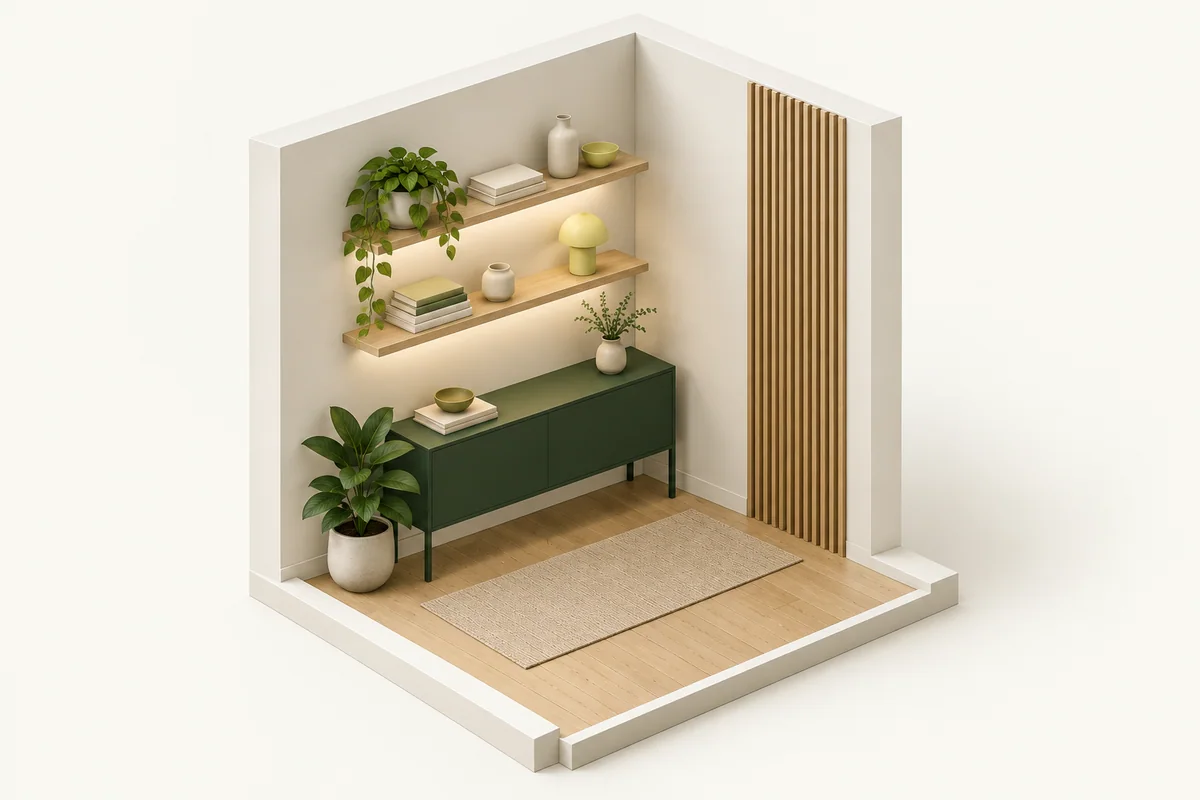
A floating shelf is a small structural system, not just a board with a width. The wall, fasteners, bracket, shelf depth, load position, and installation quality determine whether it is a practical fit.
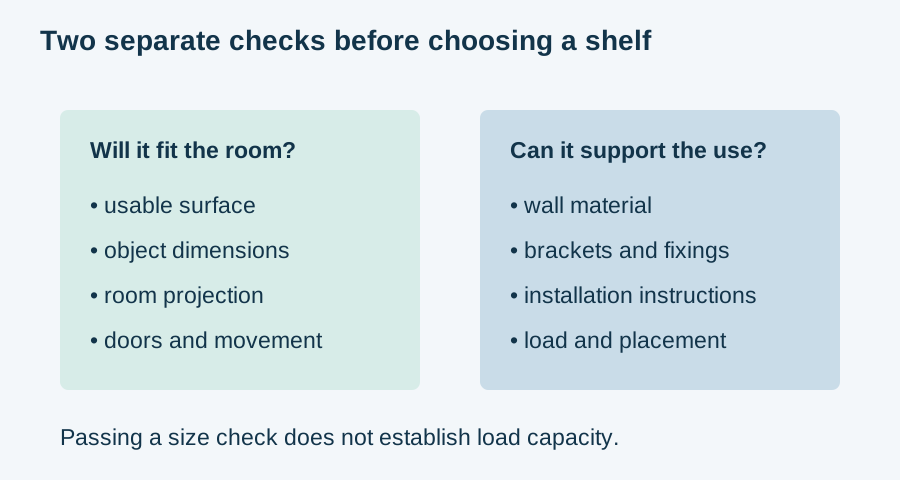
The quick answer: Check usable shelf depth and projection into the room separately from load capacity. The shelf, bracket, wall and fasteners must work as a documented system. A size match or a single anchor’s rating does not establish a safe shelf load.
Plan these three things first.
Record shelf depth plus any object that extends beyond the front edge.
02Estimate the full working loadAdd the weight of every item likely to be stored, not only the heaviest object.
03Identify the wall and mounting pointsDetermine whether the wall is drywall, plaster, masonry, or another material and locate studs where required.
Measure projection into the room
Record shelf depth plus any object that extends beyond the front edge. Check doors, curtains, seating, head clearance, and the walking path. A shelf that looks shallow on an empty wall can still intrude when bins, books, or plants are added.
Estimate the full working load
Add the weight of every item likely to be stored, not only the heaviest object. Deep shelves increase leverage because weight sits farther from the wall. Leave a conservative margin rather than planning to use the maximum rating continuously.
Identify the wall and mounting points
Determine whether the wall is drywall, plaster, masonry, or another material and locate studs where required. Use only the fasteners and spacing approved for that wall and shelf. A generic anchor package cannot override the shelf manufacturer's installation conditions.
Separate adhesive display from storage
Adhesive ledges may suit small frames or lightweight décor on approved surfaces. They are not a substitute for hardware-mounted shelving when people will store books, glass, electronics, or frequently handled items. Temperature, texture, paint condition, and removal method also matter.
Plan placement and inspection
Keep shelves away from heat, moisture, wiring, plumbing, and locations where a falling object could injure someone. Level the shelf, follow curing or tightening instructions, load it gradually, and recheck for movement or wall damage over time.
Make the decision concrete
Example: the width fits, but the intended item does not
Hypothetical measurements: a shelf is 24 inches wide and 6 inches deep, while a storage box has an 8-inch-deep base. The box would extend 2 inches past the shelf even though its width fits. Choose a surface that properly supports the object and follow the shelf instructions. Do not infer a load allowance from this example: mounting conditions, load placement and the complete shelf system still require verification.
| Check | Record | Watch for |
|---|---|---|
| Room projection | Depth including objects and nearby movement | Objects intrude into a walkway |
| Usable surface | Flat supported area after lips and brackets | Nominal depth mistaken for usable area |
| Mounting system | Wall material, fixings, bracket spacing and manual | Anchor rating treated as system capacity |
| Intended load | Every stored item and its placement | Heavy items added after initial setup |
Try your measurements
Check one dimension at a time
Use the same direction for all three inputs: width, depth or height. Add all required extra space on that axis, including movement and manufacturer clearance. Repeat for the other axes and check obstructions separately.
Enter all three measurements. Leave required extra space blank if it is unknown; do not assume zero.
Available space − product body − required extra space = space remaining
Check the original instructions
IKEA LACK: wall and mounting conditionsExample manufacturer documentation ties capacity to wall and anchoring conditions. Its rating applies only to that product and the stated conditions, not every shelf. Reference checked September 7, 2026.
See the measurements
Real products to compare with your space
These examples make the size tradeoffs easier to see. Open a product page for the complete fit verdict, setup notes, and retailer options.
Command HOM23S-2ES
Tiny renter-friendly wall spots for small frames and lightweight décor
View fit detailsUmbra Conceal Small
Books in narrow wall areas where a traditional shelf would look bulky
View fit detailsCommand HOM21S-ES
A long renter-friendly ledge for several small frames
View fit detailsDo this before placing the order.
- Measure the destination. Include the full usable width, depth, height, and every fixed obstruction.
- Measure the working position. Add door, lid, hose, ventilation, loading, and walking clearance.
- Measure the route. Check doors, halls, stairs, elevators, corners, and the storage opening.
- Verify the exact model. Compare the manufacturer documentation with the listing before buying.
What this guide cannot decide
This guide cannot identify concealed utilities, verify a wall or fastener, approve a renter modification, or certify a safe load for a specific installation.