
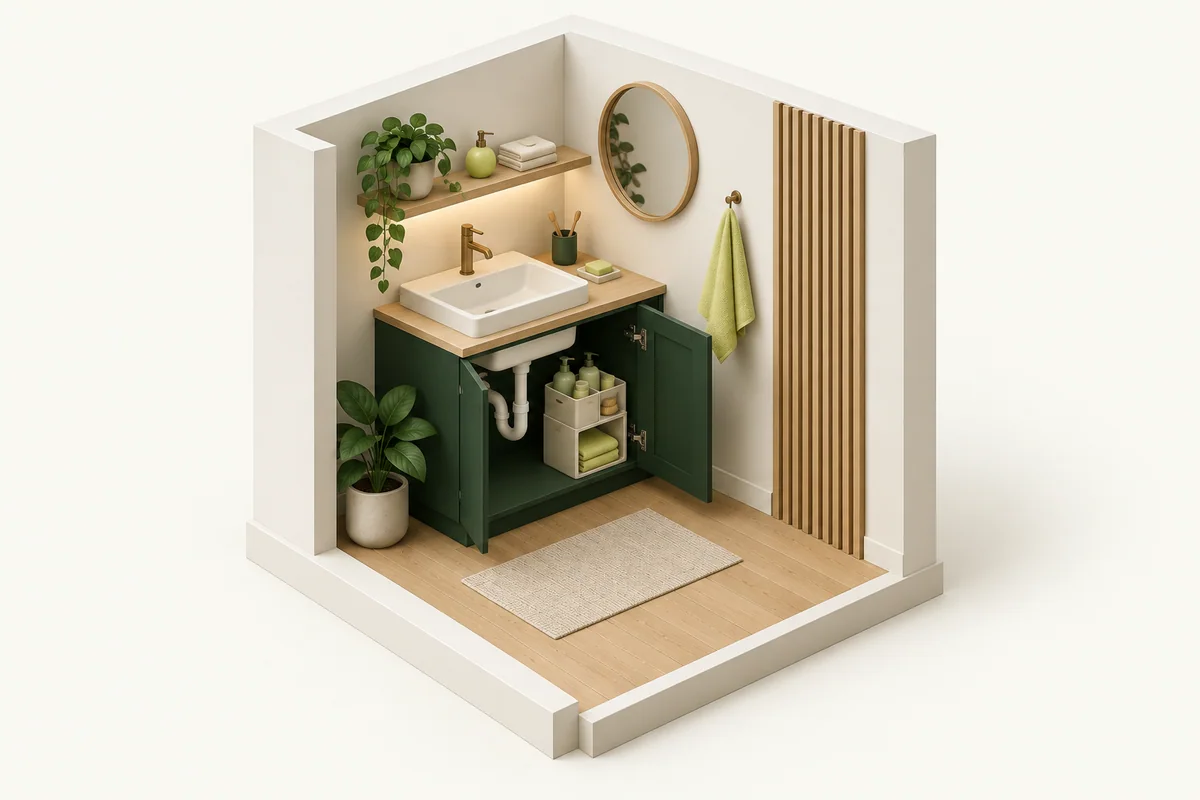
The widest empty part of an under-sink cabinet is rarely the space an organizer can use. Pipes, valves, disposals, filters, hinges, face frames, and the door opening turn the cabinet into several smaller zones.
The quick answer: Map obstructions at several heights and preserve access to the shutoffs. A clear strip on the cabinet floor may disappear at the upper shelf.
Plan these three things first.
Measure each obstruction's width, height, and distance from the cabinet walls, floor, and front opening.
02Measure the entry separatelyFace frames, center stiles, hinges, and doors can make the opening narrower than the interior.
03Trace pull-out movementA sliding drawer needs a clear path from closed to fully open.
Create a coordinate map
Measure each obstruction's width, height, and distance from the cabinet walls, floor, and front opening. Include supply lines, shutoffs, the drain trap, disposal equipment, filters, dishwasher hoses, and anything attached to the door.
Measure the entry separately
Face frames, center stiles, hinges, and doors can make the opening narrower than the interior. Confirm that the organizer can pass through the opening assembled or can be assembled safely inside.
Trace pull-out movement
A sliding drawer needs a clear path from closed to fully open. Check handles, baskets, plumbing, hinge projection, bottles, and the cabinet door position through the entire travel.
Keep the water system inspectable
Do not hide shutoffs, active connections, or areas where a leak would first appear. Use removable groups and leave a route to the valves. Storage should make leaks easier to notice, not easier to miss.
Match storage to the supplies
Measure the tallest bottle, widest package, and items that must remain upright. Keep household chemicals in their original containers and follow label guidance, especially around children, pets, food, heat, and incompatible products.
Make the decision concrete
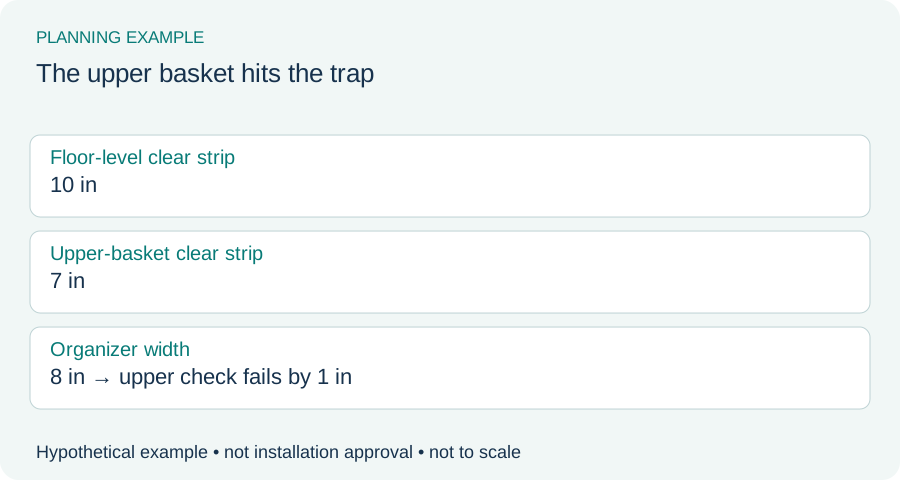
Example: the upper basket hits the trap
Hypothetical clear width beside the plumbing is 10 inches at floor level but only 7 inches at the height of an upper basket. An 8-inch-wide organizer passes the lower check but fails the upper one by 1 inch. A lower or differently shaped organizer may work, but check its opening path and loaded drawer movement independently.
| Check | Record | Watch for |
|---|---|---|
| Obstruction map | Width at every shelf and bottle height | Only floor-level clearance measured |
| Entry | Door frame, hinges and assembly route | Wide interior mistaken for wide opening |
| Service access | Valve reach and removable storage | Bin blocks access when loaded |
Try your measurements
Check one dimension at a time
Use the same direction for all three inputs: width, depth or height. Add all required extra space on that axis, including movement and manufacturer clearance. Repeat for the other axes and check obstructions separately.
Enter all three measurements. Leave required extra space blank if it is unknown; do not assume zero.
Available space − product body − required extra space = space remaining
See the measurements
Real products to compare with your space
These examples make the size tradeoffs easier to see. Open a product page for the complete fit verdict, setup notes, and retailer options.
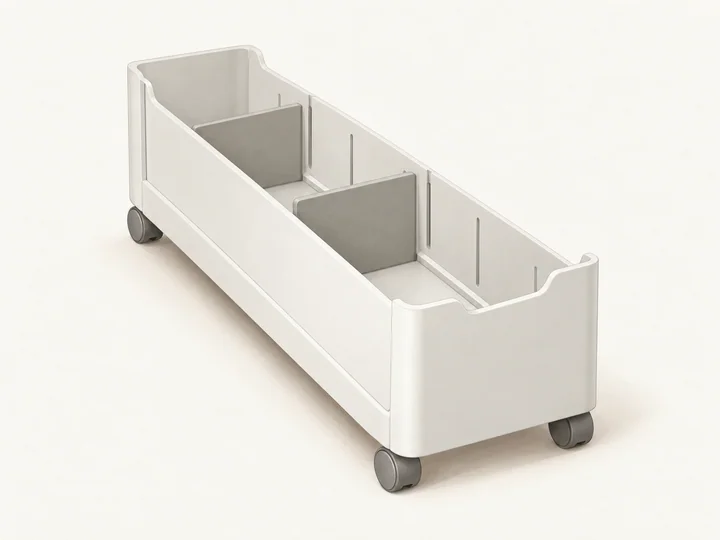
YouCopia RollOut 5-Inch Caddy
A very narrow strip beside plumbing and disposal components
View fit details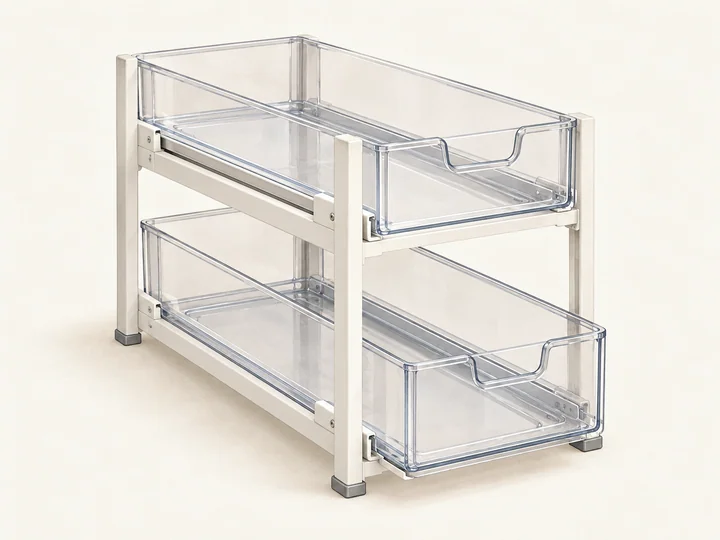
Delamu Clear Two-Tier
Bathroom cabinets where visibility and two pull-out levels matter
View fit details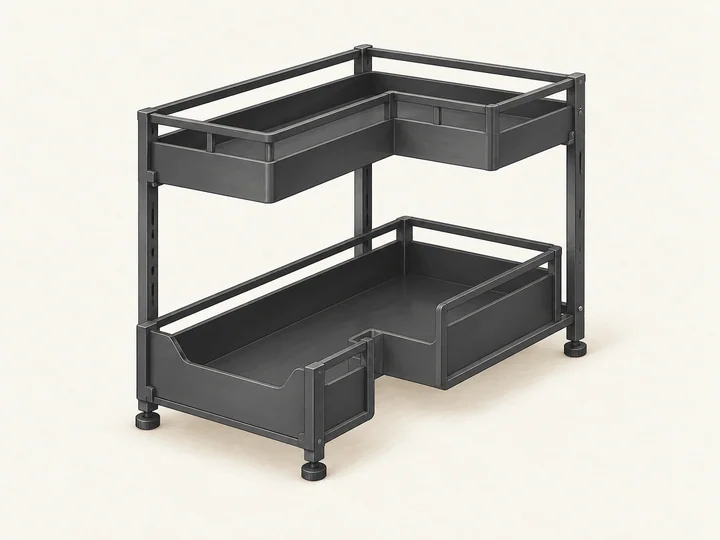
Vtopmart L-Shaped Pull-Out
Tall cleaning bottles beside low-hanging plumbing
View fit detailsDo this before placing the order.
- Measure the destination. Include the full usable width, depth, height, and every fixed obstruction.
- Measure the working position. Add door, lid, hose, ventilation, loading, and walking clearance.
- Measure the route. Check doors, halls, stairs, elevators, corners, and the storage opening.
- Verify the exact model. Compare the manufacturer documentation with the listing before buying.
What this guide cannot decide
This guide cannot inspect plumbing, approve chemical storage, diagnose a leak, or confirm that a particular pull-out system clears every obstruction in your cabinet.