
At-a-glance comparison
Compare six options by fit and setup
Start with exterior dimensions, operating clearance, access, and setup requirements. Then verify the exact model, current availability, and purchase terms at the retailer before ordering.
Affiliate disclosure: As an Amazon Associate, Small Space Buyer earns from qualifying purchases. This does not change the price you pay. Walmart links are included for comparison.
| Recommendation | Exterior size | Capacity | Setup | Retailer options |
|---|---|---|---|---|
| Smallest everyday footprintMidea MMC07S2AWWSee fit details | 17.03 W × 12.79 D × 10.19 H in. | 0.7 cu. ft. | Allow manufacturer-specified ventilation clearance | |
| Simple compact controlsCOMFEE' EM720CPL-PMBSee fit details | 17.3 W × 13 D × 10.2 H in. | 0.7 cu. ft. | Allow manufacturer-specified ventilation clearance | |
| Best narrow alternativeBLACK+DECKER EM720CB7See fit details | 17.3 W × 13 D × 10.2 H in. | 0.7 cu. ft. | Allow manufacturer-specified ventilation clearance | |
| Balanced size and powerGE JES1095SMSSSee fit details | 19 W × 14.5 D × 11.5 H in. | 0.9 cu. ft. | Allow manufacturer-specified ventilation clearance | |
| Roomier compact cavityToshiba EM925A5A-BSSee fit details | 19.2 W × 16.1 D × 11.5 H in. | 0.9 cu. ft. | Allow manufacturer-specified ventilation clearance | |
| Most cooking spacePanasonic NN-SN67KSSee fit details | 20.69 W × 15.81 D × 12.25 H in. | 1.2 cu. ft. | Allow manufacturer-specified ventilation clearance |
Decision gate
Does the complete counter footprint still work?
The cavity size is only the inside number. Compare the exterior depth, rear clearance, plug, airflow, supported counter area, open door, and the plate or container you actually use.
Use these checks to narrow the list, then open the exact specification and retailer listing for the model you are considering.
 #1 · Smallest everyday footprint
Midea · MMC07S2AWW
Midea MMC07S2AWW 0.7 Cu. Ft. Compact Countertop Microwave, 700W, Express Cook, White
Best for: The smallest microwave footprint and simple reheating
- Exterior size
- 17.03 W × 12.79 D × 10.19 H in.
- Capacity
- 0.7 cu. ft.
- Cooking power
- 700W cooking power
- Clearance
- Allow manufacturer-specified ventilation clearance
#2 · Simple compact controlsCOMFEE' · EM720CPL-PMB
COMFEE' EM720CPL-PMB 0.7 Cu. Ft. Countertop Microwave, 700W, Sound On/Off and ECO Mode
Best for: Budget-conscious shoppers who want a compact microwave with a mute option
- Exterior size
- 17.3 W × 13 D × 10.2 H in.
- Capacity
- 0.7 cu. ft.
- Cooking power
- 700W cooking power
- Clearance
- Allow manufacturer-specified ventilation clearance
#3 · Best narrow alternativeBLACK+DECKER · EM720CB7
BLACK+DECKER EM720CB7 0.7 Cu. Ft. Digital Countertop Microwave with Turntable, 700W
Best for: A familiar stainless-look compact microwave for light daily use
- Exterior size
- 17.3 W × 13 D × 10.2 H in.
- Capacity
- 0.7 cu. ft.
- Cooking power
- 700W cooking power
- Clearance
- Allow manufacturer-specified ventilation clearance
#4 · Balanced size and powerGE · JES1095SMSS
GE JES1095SMSS 0.9 Cu. Ft. Countertop Microwave Oven, 900W, Stainless Steel
Best for: Dinner plates and everyday meals without a large countertop footprint
- Exterior size
- 19 W × 14.5 D × 11.5 H in.
- Capacity
- 0.9 cu. ft.
- Cooking power
- 900W cooking power
- Clearance
- Allow manufacturer-specified ventilation clearance
#5 · Roomier compact cavityToshiba · EM925A5A-BS
Toshiba EM925A5A-BS 0.9 Cu. Ft. Countertop Microwave, 900W, ECO Mode and Sound On/Off
Best for: Quiet-control features and stronger everyday heating
- Exterior size
- 19.2 W × 16.1 D × 11.5 H in.
- Capacity
- 0.9 cu. ft.
- Cooking power
- 900W cooking power
- Clearance
- Allow manufacturer-specified ventilation clearance
#6 · Most cooking spacePanasonic · NN-SN67KS
Panasonic NN-SN67KS 1.2 Cu. Ft. Countertop Microwave with Inverter Technology, 1200W
Best for: Frequent cooking, larger dishes, and higher power where the counter allows it
- Exterior size
- 20.69 W × 15.81 D × 12.25 H in.
- Capacity
- 1.2 cu. ft.
- Cooking power
- 1200W inverter cooking
- Clearance
- Allow manufacturer-specified ventilation clearance
Affiliate disclosure: As an Amazon Associate, Small Space Buyer earns from qualifying purchases. This does not change the price you pay. Walmart links are included for comparison and may become affiliate links after program approval.
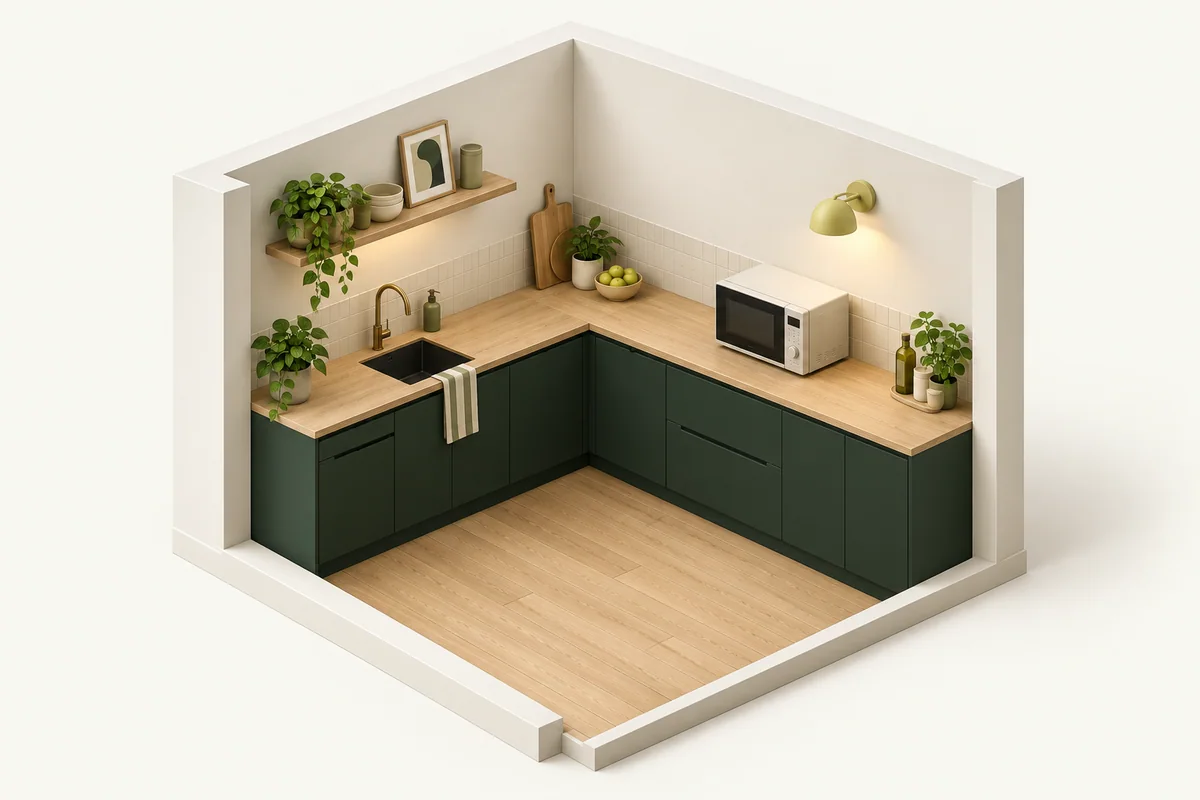
Check the space needed in use
Compare exterior dimensions, full support beneath the feet, ventilation requirements and the open door. A microwave’s cooking capacity does not tell you how much counter it needs. Keep a usable place nearby to set down a hot dish.
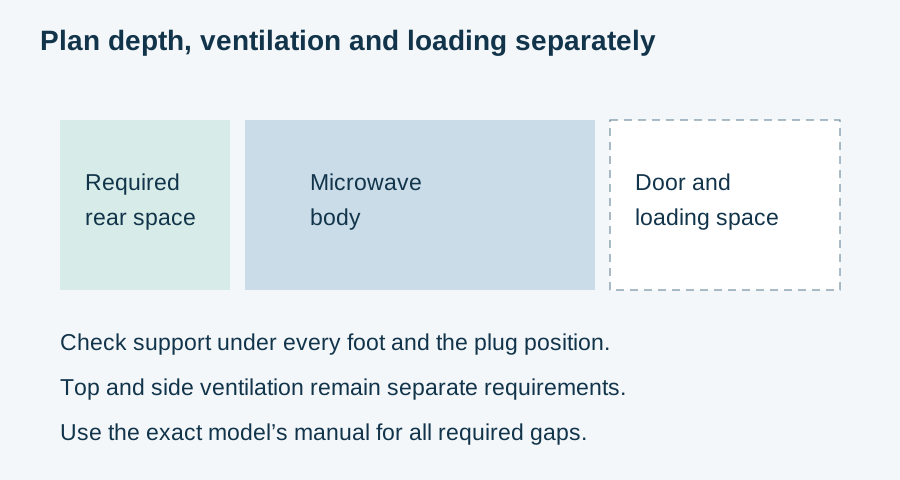
Fit guidance
How to choose for a genuinely small space
Exterior depth is the counter-space number
Two microwaves with similar cavity capacity can have different cabinet depths. Include the plug and required rear clearance, then make sure the front feet remain fully supported by the counter.
Balance wattage with the way you cook
Higher wattage generally heats faster, while very compact models can take longer and may require recipe adjustments. For reheating drinks and leftovers, the footprint may matter most. For frozen meals and regular cooking, capacity and power deserve more weight.
Plan for airflow and the open door
Countertop microwaves are not automatically suitable for enclosed shelves. Follow the ventilation instructions and measure the door in its open position, especially when the microwave will sit beside a wall, refrigerator, or tall cabinet.
Plan the complete setup
Read the guides that answer the next question.
These guides cover exact size limits, measurements, connections, and operating clearances that product listings often leave unclear.
Exact-dimension shortlist
Microwaves 18 Inches Wide or Less
Compare countertop microwaves 18 inches wide or less by exterior depth, height, cavity capacity, wattage, turntable, and ventilation.
See qualifying products Buying guideMicrowave depth and counter clearance
Measure the feet, plug, airflow, working surface, and open door.
Read the guide Buying guideCountertop clearance guide
Plan heat, ventilation, cabinet height, and everyday working room.
Read the guide Buying guideTiny-kitchen counter organization
Map the working counter before adding another appliance.
Read the guideCommon questions
Best Microwaves for Small Kitchens: FAQ
What microwave size is best for a small kitchen?
Choose the smallest exterior cabinet that still fits your usual plate or container and meets your wattage needs. Cubic-foot capacity alone does not tell you the counter footprint.
Can a countertop microwave go on a shelf?
Only when the shelf supports the appliance and the placement meets the manufacturer's ventilation, electrical, and clearance instructions.
Does a compact microwave use less electricity?
Not necessarily. Check the rated input power and circuit requirements; exterior size and cooking wattage are related but not interchangeable.
Use your measurements