
At-a-glance comparison
Compare six options by fit and setup
Start with exterior dimensions, operating clearance, access, and setup requirements. Then verify the exact model, current availability, and purchase terms at the retailer before ordering.
Affiliate disclosure: As an Amazon Associate, Small Space Buyer earns from qualifying purchases. This does not change the price you pay. Walmart links are included for comparison.
| Recommendation | Exterior size | Capacity | Setup | Retailer options |
|---|---|---|---|---|
| Small-room compact pickBLACK+DECKER BPT08WTBSee fit details | 16.5 W × 14.1 D × 27.1 H in. | Small rooms | Single exhaust hose and window kit required | |
| Balanced bedroom optionHisense AP0525CR1WSee fit details | 13.3 W × 11.8 D × 26.7 H in. | Up to 150 sq. ft. | Single exhaust hose and window kit required | |
| Easy everyday controlsLG LP0621WSRSee fit details | 17.32 W × 13.27 D × 27.36 H in. | Up to 250 sq. ft. | Single exhaust hose and window kit required | |
| Larger-room step-upMidea MAP08S1JWT-BSee fit details | 17.44 W × 13.74 D × 28.66 H in. | Up to 350 sq. ft. | Single exhaust hose and window kit required | |
| High-capacity apartment pickMidea MPX0812CWRUSee fit details | 16.14 W × 11.81 D × 27.36 H in. | Up to 450 sq. ft. | Single exhaust hose and window kit required | |
| Maximum cooling optionWhynter ARC-14SSee fit details | 16 W × 19 D × 35.5 H in. | Large rooms | Dual exhaust hoses and compatible window kit required |
Decision gate
Can the room accept the exhaust and power requirements?
Portable cooling only works when the window kit, hose route, rear clearance, outlet, drainage plan, and room conditions work together. A larger BTU label cannot compensate for a blocked exhaust path.
Use these checks to narrow the list, then open the exact specification and retailer listing for the model you are considering.
 #1 · Small-room compact pick
BLACK+DECKER · BPT08WTB
BLACK+DECKER BPT08WTB 8,000 BTU Portable Air Conditioner with Follow Me Remote
Best for: Very small rooms where floor footprint matters most
- Exterior size
- 16.5 W × 14.1 D × 27.1 H in.
- Room coverage
- Small rooms
- Cooling
- 8,000 BTU ASHRAE
- Exhaust setup
- Single exhaust hose and window kit required
#2 · Balanced bedroom optionHisense · AP0525CR1W
Hisense AP0525CR1W 5,000 BTU DOE Portable Air Conditioner for Rooms up to 150 Sq. Ft.
Best for: Bedrooms and offices around 150 square feet
- Exterior size
- 13.3 W × 11.8 D × 26.7 H in.
- Room coverage
- Up to 150 sq. ft.
- Cooling
- 5,000 BTU DOE
- Exhaust setup
- Single exhaust hose and window kit required
#3 · Easy everyday controlsLG · LP0621WSR
LG LP0621WSR 6,000 BTU Portable Air Conditioner with 3-in-1 Operation for Rooms up to 250 Sq. Ft.
Best for: Bedrooms and medium rooms needing a balanced size-to-cooling ratio
- Exterior size
- 17.32 W × 13.27 D × 27.36 H in.
- Room coverage
- Up to 250 sq. ft.
- Cooling
- 6,000 BTU SACC
- Exhaust setup
- Single exhaust hose and window kit required
#4 · Larger-room step-upMidea · MAP08S1JWT-B
Midea MAP08S1JWT-B 8,000 BTU Smart Inverter Portable Air Conditioner for Rooms up to 350 Sq. Ft.
Best for: Larger bedrooms and living areas with smart control
- Exterior size
- 17.44 W × 13.74 D × 28.66 H in.
- Room coverage
- Up to 350 sq. ft.
- Cooling
- 8,000 BTU DOE
- Exhaust setup
- Single exhaust hose and window kit required
#5 · High-capacity apartment pickMidea · MPX0812CWRU
Midea MPX0812CWRU Smart Portable Air Conditioner, 8,000 BTU DOE, for Rooms up to 450 Sq. Ft.
Best for: High room-coverage needs in a relatively narrow cabinet
- Exterior size
- 16.14 W × 11.81 D × 27.36 H in.
- Room coverage
- Up to 450 sq. ft.
- Cooling
- 8,000 BTU DOE
- Exhaust setup
- Single exhaust hose and window kit required
#6 · Maximum cooling optionWhynter · ARC-14S
Whynter ARC-14S 14,000 BTU Dual-Hose Portable Air Conditioner, Dehumidifier and Fan
Best for: Maximum cooling and dual-hose operation where height and depth are available
- Exterior size
- 16 W × 19 D × 35.5 H in.
- Room coverage
- Large rooms
- Cooling
- 14,000 BTU ASHRAE
- Exhaust setup
- Dual exhaust hoses and compatible window kit required
Affiliate disclosure: As an Amazon Associate, Small Space Buyer earns from qualifying purchases. This does not change the price you pay. Walmart links are included for comparison and may become affiliate links after program approval.
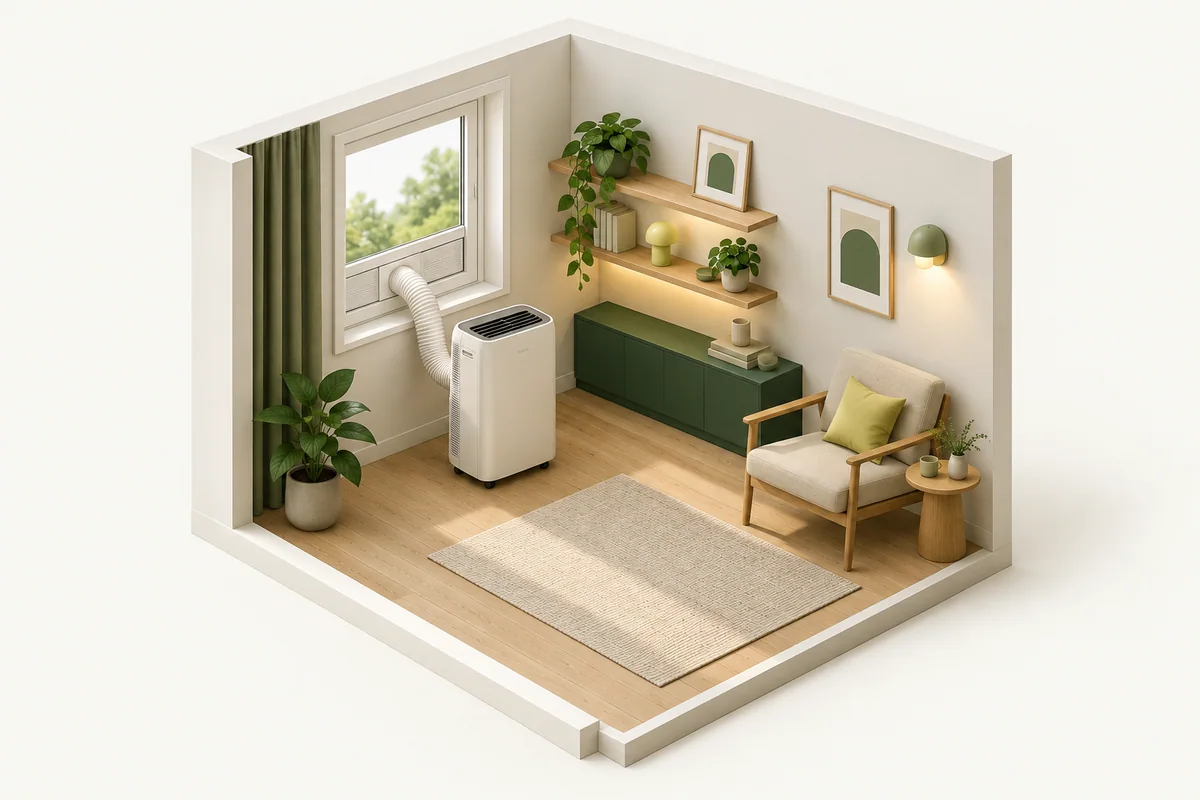
Check the space needed in use
Start with the window type and the exact panel kit, then measure the permitted exhaust-hose route to a usable floor position. A small cabinet and a large cooling rating cannot compensate for an incompatible window.
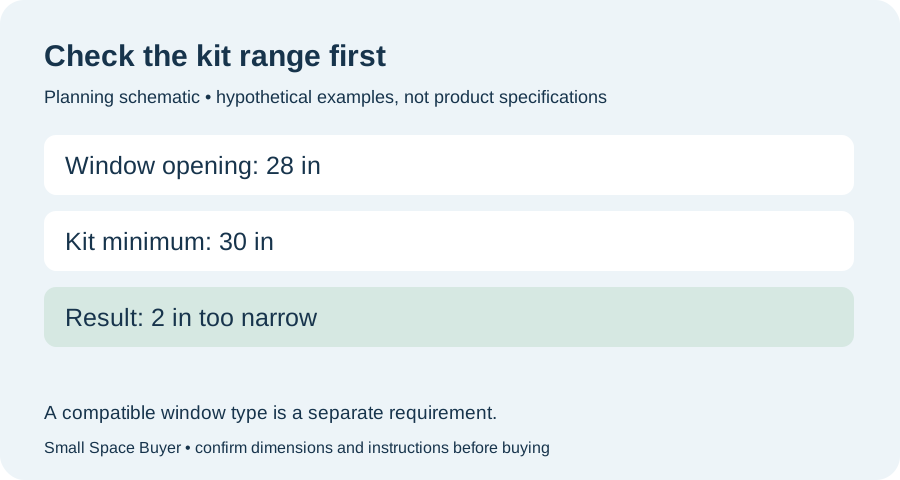
Fit guidance
How to choose for a genuinely small space
The exhaust route determines whether it works
A portable AC moves heat out through a hose and window kit. Measure the window opening and the path from the unit to the window, keep the hose as short and straight as the manufacturer recommends, and confirm your building allows the kit.
Use the current room-size rating
Portable AC listings may show more than one BTU number. Compare the current DOE or SACC capacity and the manufacturer's recommended room size, then adjust expectations for strong sun, high ceilings, open doorways, kitchens, and poor insulation.
Plan for power, noise, and condensate
These units draw substantial power and should be used on the outlet and circuit described in the manual. Noise is produced inside the room, unlike many window units. In humid conditions, some models also need periodic or continuous drainage.
Plan the complete setup
Read the guides that answer the next question.
These guides cover exact size limits, measurements, connections, and operating clearances that product listings often leave unclear.
Exact-dimension shortlist
Portable Air Conditioners 18 Inches Wide or Less
Compare portable AC units 18 inches wide or less by depth, height, DOE capacity, room coverage, exhaust kit, and drainage.
See qualifying products Buying guideWindow-kit measurement and exhaust setup
Check the opening, panel range, hose route, floor space, and drainage.
Read the guide Buying guideMeasure any small space
Record hard boundaries, operating clearance, and the path into the room.
Read the guide Buying guideApartment cooling without central air
Plan room coverage, exhaust, electricity, drainage, and noise.
Read the guideCommon questions
Best Portable Air Conditioners for Apartments: FAQ
Do portable air conditioners have to vent outside?
Yes. The hot exhaust air needs to leave through a compatible window or another manufacturer-approved opening.
Which BTU number should I compare?
For portable units, use the current DOE or SACC capacity and the manufacturer's room-size guidance rather than comparing only an older, higher ASHRAE number.
Can I use a portable AC with an extension cord?
Follow the manufacturer and local electrical requirements. Many manuals warn against extension cords because air conditioners draw substantial current.
Use your measurements