
At-a-glance comparison
Compare six options by fit and setup
Start with exterior dimensions, operating clearance, access, and setup requirements. Then verify the exact model, current availability, and purchase terms at the retailer before ordering.
Affiliate disclosure: As an Amazon Associate, Small Space Buyer earns from qualifying purchases. This does not change the price you pay. Walmart links are included for comparison.
| Recommendation | Exterior size | Capacity | Setup | Retailer options |
|---|---|---|---|---|
| Shallowest footprintYamazaki Home Tower TallSee fit details | 8.66 W × 7.09 D × 30.51 H in. | Up to five pairs | Assembly required; movable top handle | |
| Best open rackHOMCOM 837-142V80BKSee fit details | 30 W × 7.5 D × 46 H in. | Up to 12 pairs | Assembly and anti-tip anchoring required | |
| Best vertical towerIKEA BISSA Three-CompartmentSee fit details | 19.25 W × 11 D × 53.13 H in. | Approximately 12 pairs | Must be fixed to the wall | |
| Best flip-drawer cabinetMainstays Three-Tier Shoe CabinetSee fit details | 23.6 W × 9.4 D × 47.2 H in. | Approximately 12–18 pairs | Wall mounting and assembly required | |
| Best concealed optionVASAGLE LBC03See fit details | 23.62 W × 9.45 D × 47.24 H in. | Approximately 12–18 pairs | Assembly and anti-tip anchoring required | |
| Highest pair capacityKavey Metal Three-DrawerSee fit details | 31.5 W × 6.3 D × 47.2 H in. | Listed for 18–24 pairs | Wall or floor mounting; assembly required |
Decision gate
Does the cabinet work with the door open?
A slim entry cabinet saves floor depth only if shoes fit, doors can open, and people can pass. Compare the closed footprint with the loaded depth, largest footwear, walking route, and tip-restraint needs.
Use these checks to narrow the list, then open the exact specification and retailer listing for the model you are considering.
 #1 · Shallowest footprint
Yamazaki Home · Tower Tall
Yamazaki Home Tower Tall Slim Vertical Shoe Rack for Five Pairs
Best for: Stacking five everyday pairs in less than nine inches of floor width
- Exterior size
- 8.66 W × 7.09 D × 30.51 H in.
- Shoe capacity
- Up to five pairs
- Storage style
- Open vertical steel tower
- Safety
- Assembly required; movable top handle
#2 · Best open rackHOMCOM · 837-142V80BK
HOMCOM Narrow Three-Drawer Flip Shoe Cabinet for Up to 12 Pairs
Best for: A narrow hallway where concealed storage must stay under eight inches deep
- Exterior size
- 30 W × 7.5 D × 46 H in.
- Shoe capacity
- Up to 12 pairs
- Storage style
- Three shallow flip drawers
- Safety
- Assembly and anti-tip anchoring required
#3 · Best vertical towerIKEA · BISSA Three-Compartment
IKEA BISSA Three-Compartment Shoe Cabinet in White
Best for: A very narrow wall run where width matters more than height
- Exterior size
- 19.25 W × 11 D × 53.13 H in.
- Shoe capacity
- Approximately 12 pairs
- Storage style
- Three tilt-out compartments
- Safety
- Must be fixed to the wall
#4 · Best flip-drawer cabinetMainstays · Three-Tier Shoe Cabinet
Mainstays Three-Tier Wall-Mounted Shoe Storage Cabinet, White
Best for: Concealing a larger shoe collection in a shallow vertical cabinet
- Exterior size
- 23.6 W × 9.4 D × 47.2 H in.
- Shoe capacity
- Approximately 12–18 pairs
- Storage style
- Three concealed tilt-out tiers
- Safety
- Wall mounting and assembly required
#5 · Best concealed optionVASAGLE · LBC03
VASAGLE Three-Door Tilt-Out Shoe Cabinet with Adjustable Compartments
Best for: Adjustable concealed storage for mixed flats, sneakers, and heels
- Exterior size
- 23.62 W × 9.45 D × 47.24 H in.
- Shoe capacity
- Approximately 12–18 pairs
- Storage style
- Three adjustable flip compartments
- Safety
- Assembly and anti-tip anchoring required
#6 · Highest pair capacityKavey · Metal Three-Drawer
Kavey Modern Metal Shoe Cabinet with Three Flip Drawers for 18–24 Pairs
Best for: Maximum concealed capacity with an exceptionally shallow 6.3-inch depth
- Exterior size
- 31.5 W × 6.3 D × 47.2 H in.
- Shoe capacity
- Listed for 18–24 pairs
- Storage style
- Ventilated all-steel flip drawers
- Safety
- Wall or floor mounting; assembly required
Affiliate disclosure: As an Amazon Associate, Small Space Buyer earns from qualifying purchases. This does not change the price you pay. Walmart links are included for comparison and may become affiliate links after program approval.
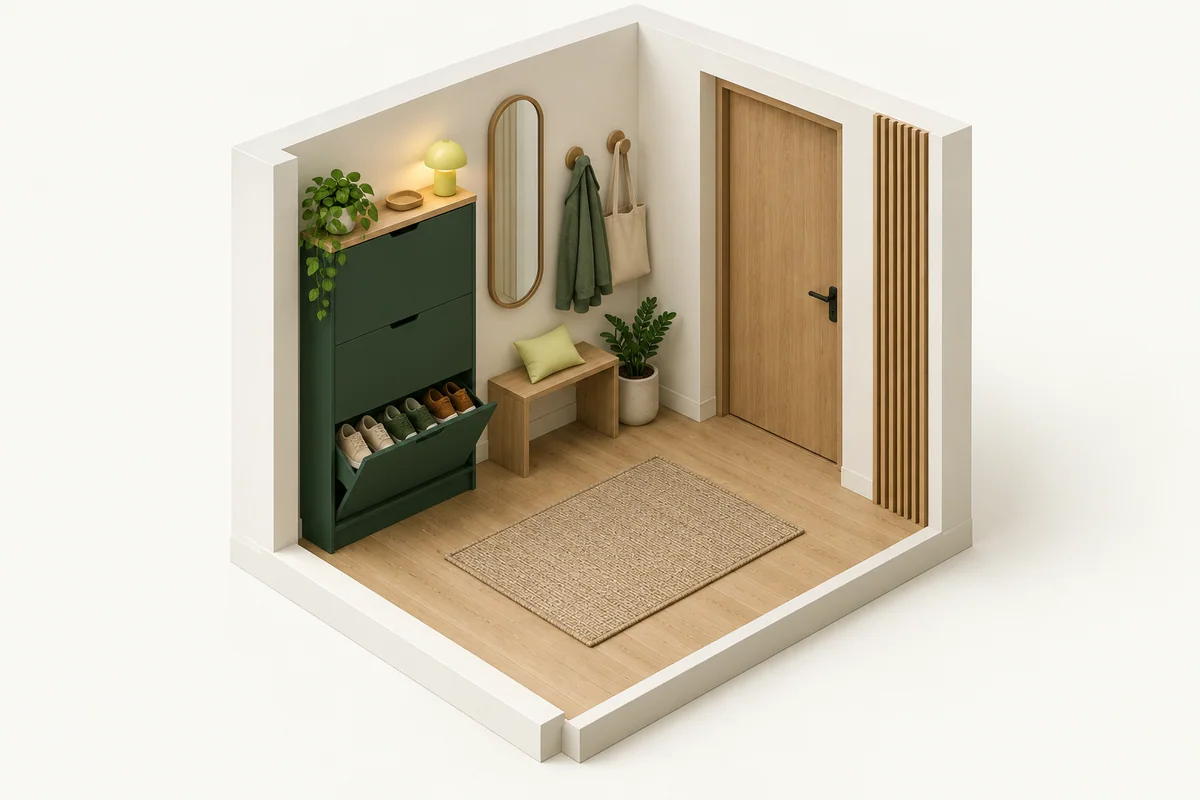
Check the space needed in use
Measure the cabinet with its storage compartment fully open, then add the space you need to stand and remove shoes. Test the entrance door and walking route in that position. A shallow closed cabinet can still be too deep for daily use.
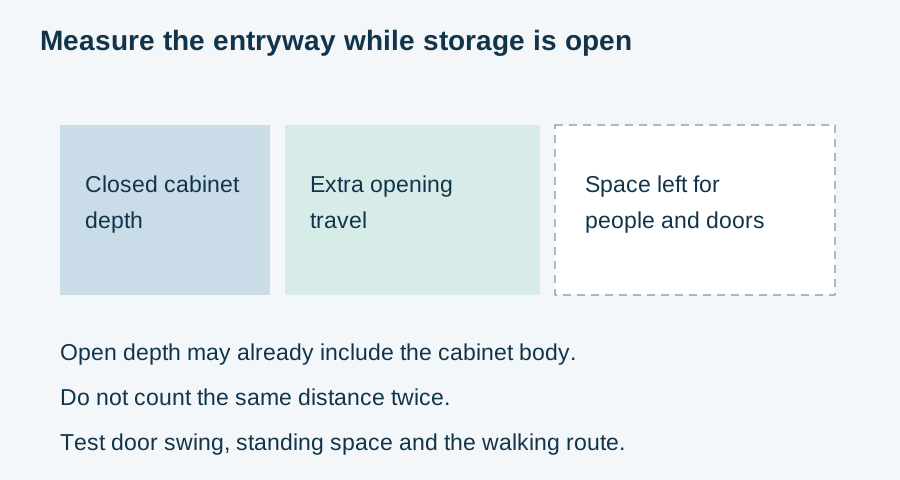
Fit guidance
How to choose for a genuinely small space
Protect the walking route
Measure the entryway at its narrowest point and include trim, radiators, vents, and the door swing. Mark the cabinet's closed footprint with tape and verify that people can enter, turn, and carry bags without clipping it.
Capacity depends on footwear
Pair counts usually assume smaller low shoes arranged efficiently. Measure the longest and tallest footwear, note boots and high-tops separately, and check whether internal dividers adjust or remove.
Compare open and operating depth
Flip drawers and cabinet doors keep the closed profile shallow but extend into the walkway during use. Open racks are quick to access but expose clutter. Add handle projection, base depth, and the user's standing position.
Plan the complete setup
Read the guides that answer the next question.
These guides cover exact size limits, measurements, connections, and operating clearances that product listings often leave unclear.
Exact-dimension shortlist
Shoe Storage 10 Inches Deep or Less
Compare shallow shoe organizers 10 inches deep or less by width, height, pair capacity, open depth, shoe fit, and restraint.
See qualifying products Buying guideShoe cabinet depth and door clearance
Measure the walkway, front door, drawers, shoe length, and stability plan.
Read the guide Buying guideNarrow cabinet stability
Plan leveling, loading, and required wall restraint.
Read the guide Buying guideNarrow entryway storage planning
Preserve the door and walking route around everyday storage.
Read the guideCommon questions
Best Shoe Storage for Narrow Entryways: FAQ
How deep is a narrow shoe cabinet when open?
It varies by drawer or door design. Use the manufacturer's open dimensions when available or add the moving panel's full swing to the closed cabinet depth.
Will a slim cabinet fit large shoes?
Not automatically. Compare internal depth and adjustable-divider information with the longest shoe, rather than relying on the advertised pair count.
Do flip-drawer shoe cabinets need anchoring?
Follow the product instructions. Tall shallow cabinets can become unstable when drawers open and often require wall restraint.
Use your measurements