
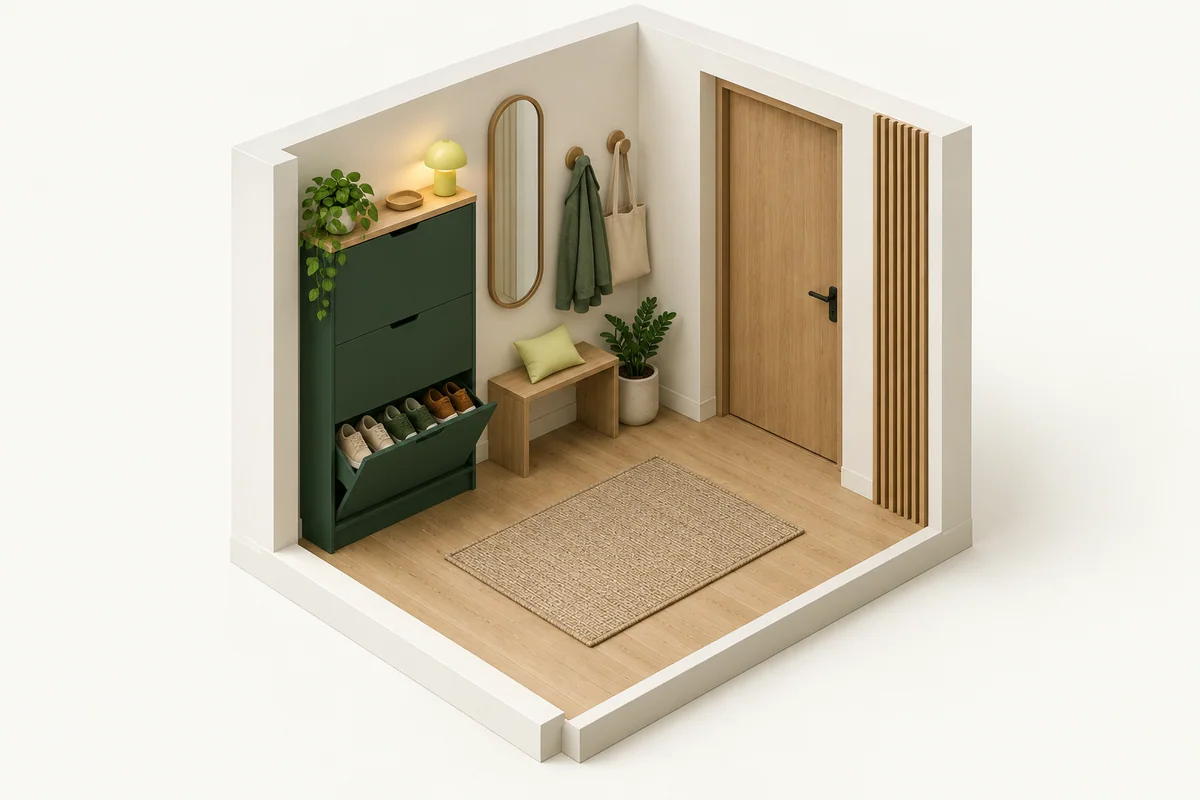
A shoe cabinet can be shallow while closed and still consume the entire entryway when its drawers or doors open. Real fit also depends on the length and shape of the shoes stored inside.
The quick answer: Measure the cabinet with its storage compartment fully open, then add the space you need to stand and remove shoes. Test the entrance door and walking route in that position. A shallow closed cabinet can still be too deep for daily use.
Plan these three things first.
Measure from the proposed cabinet front to the opposite wall or obstruction.
02Add the open depthRecord how far flip drawers, hinged doors, or pull-out bins extend, plus the standing space needed to load shoes.
03Measure the largest footwearUse the length, width, and height of the largest everyday shoes.
Protect the entrance route
Measure from the proposed cabinet front to the opposite wall or obstruction. Open the exterior door fully, carry a bag through the space, and keep required paths and building access clear.
Add the open depth
Record how far flip drawers, hinged doors, or pull-out bins extend, plus the standing space needed to load shoes. A shallow closed profile does not help if every use blocks the doorway.
Measure the largest footwear
Use the length, width, and height of the largest everyday shoes. Boots and high-tops may need separate open storage. Check whether dividers can be adjusted without reducing stability or violating instructions.
Treat pair counts as estimates
Advertised capacity often assumes smaller low shoes. Wider adult sizes, thick soles, and irregular footwear reduce the real number of pairs. Internal dimensions and shelf spacing are more useful than a headline count.
Plan restraint and daily loading
Tall shallow cabinets may require wall attachment. Follow assembly, leveling, anchoring, and loading instructions, especially when flip drawers change the center of gravity or children can reach the unit.
Make the decision concrete
Example: shallow when closed, crowded when open
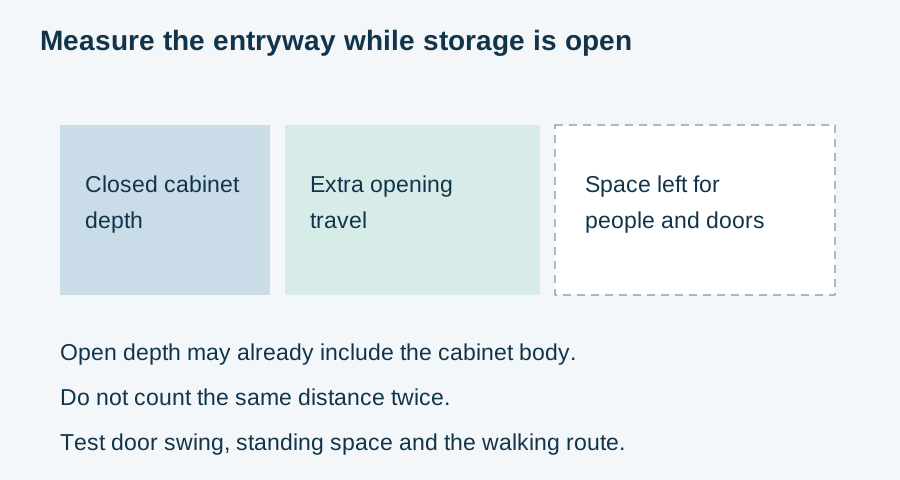
Hypothetical entryway: 40 inches are available from the placement wall to the opposite obstruction. A cabinet 9 inches deep with 12 inches of additional drawer projection occupies 21 inches when open, leaving 19 inches before a person stands there. That remainder is not an approved passage width. Test the actual entrance, occupants and bags, and follow applicable access requirements. Check whether the product’s stated open depth already includes its closed body so you do not count it twice.
| Check | Record | Watch for |
|---|---|---|
| Closed depth | Body, handles and baseboard offset | Cabinet sits farther out than the listing |
| Open depth | Full extension measured from the same wall | Closed depth counted twice |
| Footwear | Largest shoe length, width and height | Pair count assumes smaller shoes |
| Access and restraint | Door travel, standing space and mounting instructions | Cabinet blocks entrance or cannot be secured |
Try your measurements
Check one dimension at a time
Use the same direction for all three inputs: width, depth or height. Add all required extra space on that axis, including movement and manufacturer clearance. Repeat for the other axes and check obstructions separately.
Enter all three measurements. Leave required extra space blank if it is unknown; do not assume zero.
Available space − product body − required extra space = space remaining
See the measurements
Real products to compare with your space
These examples make the size tradeoffs easier to see. Open a product page for the complete fit verdict, setup notes, and retailer options.
Yamazaki Home Tower Tall
Stacking five everyday pairs in less than nine inches of floor width
View fit detailsHOMCOM 837-142V80BK
A narrow hallway where concealed storage must stay under eight inches deep
View fit detailsIKEA BISSA Three-Compartment
A very narrow wall run where width matters more than height
View fit detailsDo this before placing the order.
- Measure the destination. Include the full usable width, depth, height, and every fixed obstruction.
- Measure the working position. Add door, lid, hose, ventilation, loading, and walking clearance.
- Measure the route. Check doors, halls, stairs, elevators, corners, and the storage opening.
- Verify the exact model. Compare the manufacturer documentation with the listing before buying.
What this guide cannot decide
This guide cannot verify egress rules, wall fastening, child safety, renter permission, or footwear capacity for a particular cabinet.