
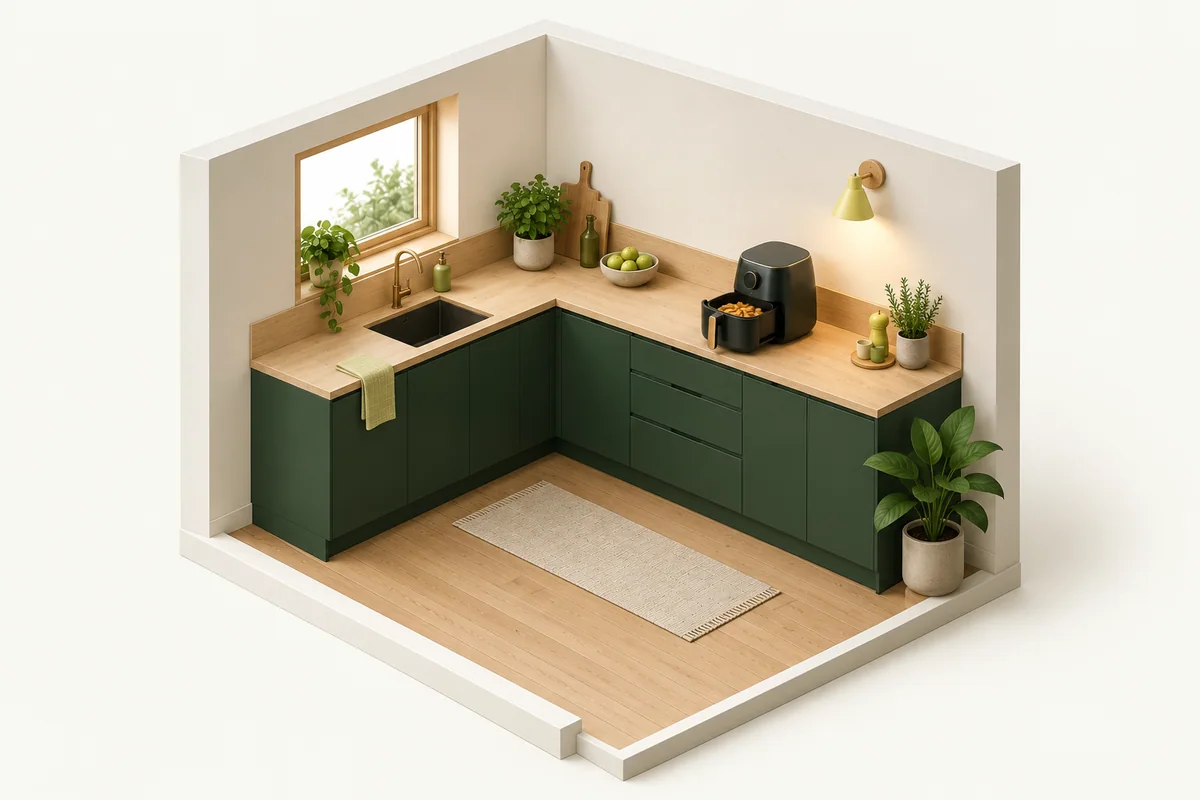
The smallest air fryer cabinet can require a much larger safe operating area. Hot exhaust, a pulled-out basket, an open door, the cord, and a place for hot food all extend beyond the product dimensions.
The quick answer: Plan two layouts: where the cooled appliance is stored and where it operates. The cooking position must satisfy the exact manual’s ventilation requirements and leave room for the basket, your hands and a suitable hot-part landing area.
Plan these three things first.
Identify the air intake and hot exhaust locations and follow the model-specific side, rear, and overhead requirements.
02Pull the basket or door fully openMeasure handle projection, drawer travel, open-door depth, and the user's standing position.
03Plan a heat-safe landing areaSet aside clear counter space for the hot basket, rack, or food container if the manual permits removal.
Use the exact manual clearances
Identify the air intake and hot exhaust locations and follow the model-specific side, rear, and overhead requirements. A machine that stores below an upper cabinet may need to move forward into a more open position for cooking.
Pull the basket or door fully open
Measure handle projection, drawer travel, open-door depth, and the user's standing position. Keep the hot component supported and away from walkways, sink edges, burners, and surfaces that can be damaged by heat.
Plan a heat-safe landing area
Set aside clear counter space for the hot basket, rack, or food container if the manual permits removal. Avoid a layout that requires carrying hot parts across the room or placing them on an unsuitable surface.
Check power and cord reach
Use the outlet and circuit described by the manufacturer, keep the cord away from heat and water, and avoid unapproved extension arrangements. High cooking wattage can matter even when the appliance exterior is small.
Measure cleanup and storage
Confirm the basket, tray, and rack fit the sink or dishwasher as permitted. If the appliance is stored between uses, allow it to cool fully and make sure the lifting and storage path is realistic for its weight and shape.
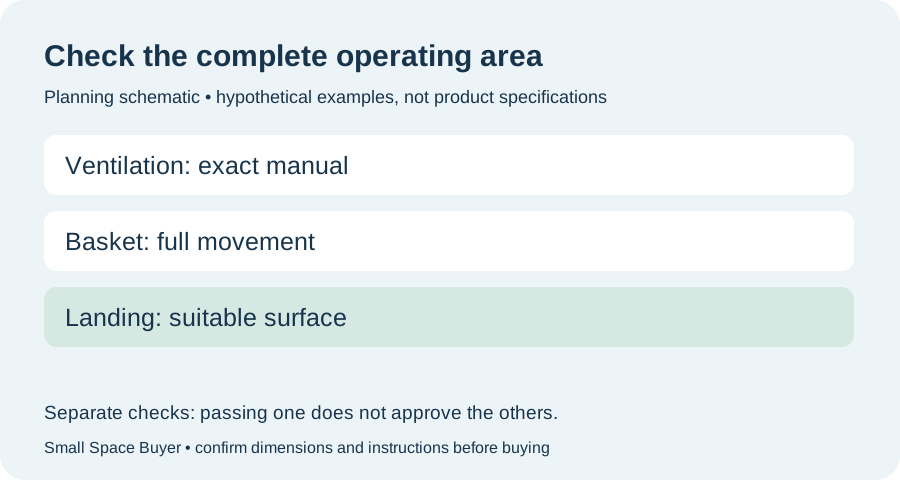
Make the decision concrete
Example: the closed footprint hides a failed basket check
Hypothetical dimensions: 24 inches are available from the rear wall to the counter edge. An appliance body is 14 inches deep, its hypothetical required rear gap is 5 inches, and basket movement adds another 7 inches beyond the measured closed front. The total reach is 26 inches, exceeding that 24-inch zone by 2 inches. This simple check is a reason to reassess the layout, not permission to support a hot basket over the edge. Use your exact model’s requirements; the 5-inch gap is not a universal recommendation. Measure side and top ventilation, approved surface and landing space separately, and do not double-count a handle already included in the body depth.
| Check | Record | Watch for |
|---|---|---|
| Operating position | Manual's side, rear and top clearances | Storage location assumed suitable for cooking |
| Basket or door | Full reach including handle and hand access | Closed depth treated as full operating depth |
| Landing area | Stable surface suitable for hot components | Hot basket has nowhere suitable to rest |
| After cooking | Cooling, cleaning and storage instructions | Moving or enclosing a hot appliance |
Try your measurements
Check one dimension at a time
Use the same direction for all three inputs: width, depth or height. Add all required extra space on that axis, including movement and manufacturer clearance. Repeat for the other axes and check obstructions separately.
Enter all three measurements. Leave required extra space blank if it is unknown; do not assume zero.
Available space − product body − required extra space = space remaining
See the measurements
Real products to compare with your space
These examples make the size tradeoffs easier to see. Open a product page for the complete fit verdict, setup notes, and retailer options.
DASH Aircrisp Pro 2 Qt
The narrowest one-person air-fryer footprint
View fit detailsChefman RJ38-2D
A tiny counter that still benefits from digital temperature control
View fit detailsNinja AF080 Mini
Simple one-person cooking in an eight-inch-wide appliance body
View fit detailsDo this before placing the order.
- Measure the destination. Include the full usable width, depth, height, and every fixed obstruction.
- Measure the working position. Add door, lid, hose, ventilation, loading, and walking clearance.
- Measure the route. Check doors, halls, stairs, elevators, corners, and the storage opening.
- Verify the exact model. Compare the manufacturer documentation with the listing before buying.
What this guide cannot decide
This guide cannot approve appliance ventilation, counter material, electrical capacity, heat exposure, cleaning method, or operation in a particular kitchen.