
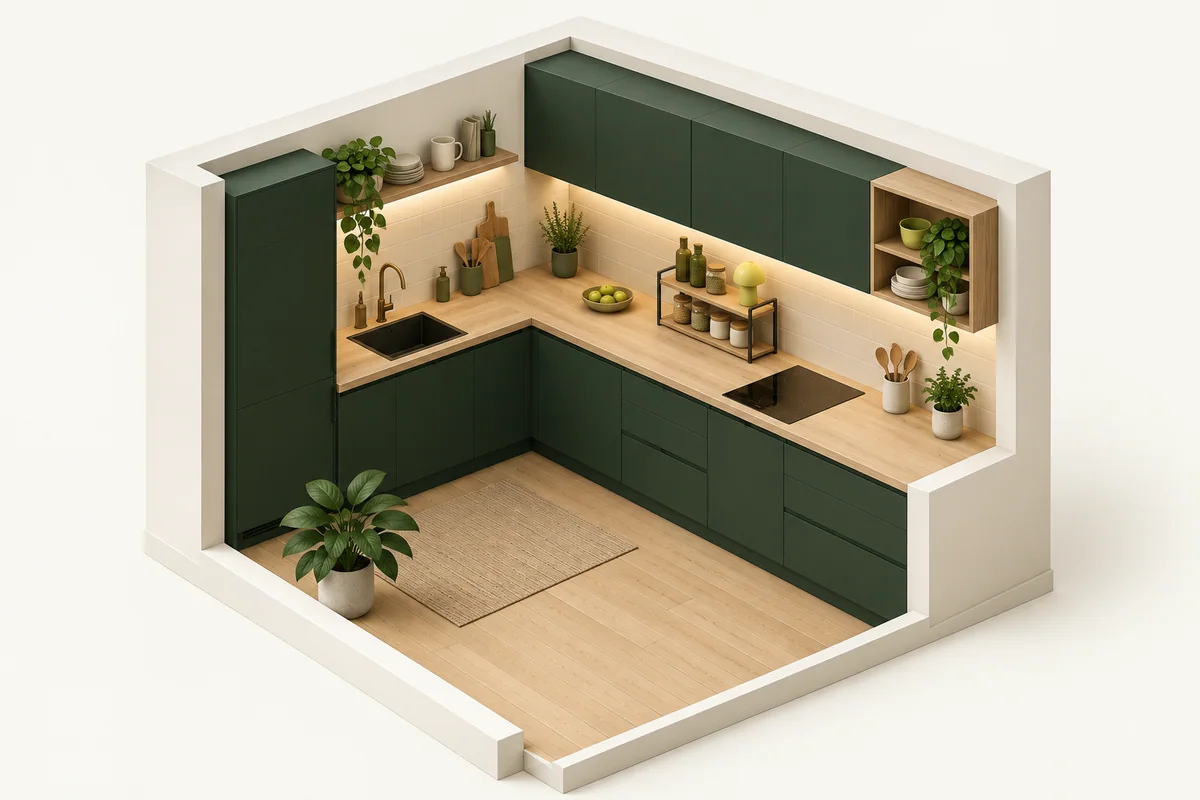
Countertop storage works best when it uses empty vertical space without blocking the items, outlets, cabinets, or food-preparation area that make the counter useful.
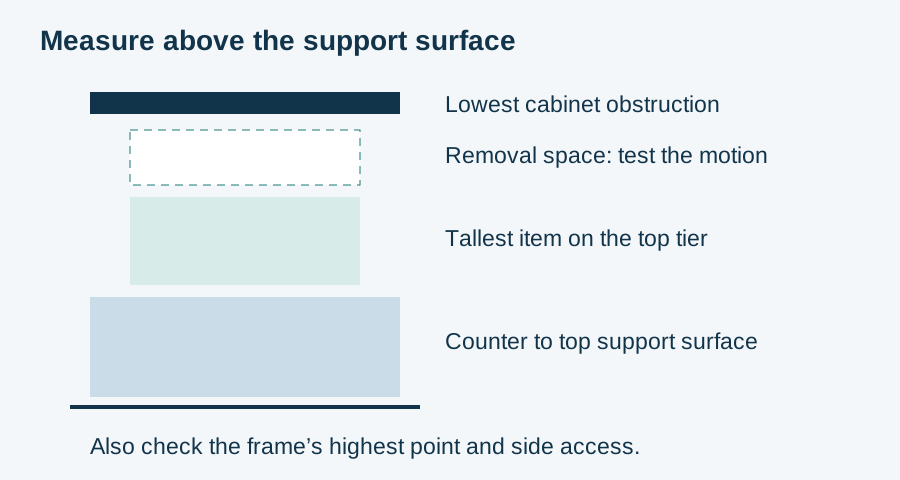
The quick answer: Measure from the counter to the lowest cabinet obstruction, then compare the loaded organizer height plus removal space. For an open top tier, use the height of its support surface plus the tallest item; do not automatically add an item’s full height to a frame that already surrounds it.
Plan these three things first.
Record the distance from the counter to the lowest cabinet edge, trim, light, or outlet.
02Add the stored itemsThe organizer's published height does not include bottles, appliances, or containers on its top tier.
03Check tier spacing and accessCompare the clear height and width within each tier with the objects assigned to it.
Measure the vertical opening
Record the distance from the counter to the lowest cabinet edge, trim, light, or outlet. Check more than one point because counters and cabinets are not always level. Use the smallest verified height.
Add the stored items
The organizer's published height does not include bottles, appliances, or containers on its top tier. Add the tallest item plus enough hand clearance to lift or tilt it out without hitting the cabinet.
Check tier spacing and access
Compare the clear height and width within each tier with the objects assigned to it. A shelf can technically hold a bottle that is too awkward to remove during daily use. Turntables and pull-outs also need room to move.
Keep utilities usable
Do not cover outlets, switches, backsplash controls, windows, or shutoffs. Keep cords away from sinks and hot surfaces, and preserve the clearances required by any appliance placed on or below the organizer.
Protect working counter space
Mark the full footprint and test the remaining space for preparation, grocery unloading, and landing hot dishes. If the organizer forces constant moving and restacking, a cabinet or wall solution may be more practical.
Make the decision concrete
Example: the empty organizer fits, but the bottles do not
Hypothetical measurements: there are 18 inches below an upper cabinet. The top support surface is 10 inches above the counter and the tallest bottle is 7 inches high, so the loaded height is 17 inches. Only 1 inch remains before accounting for lifting or tilting the bottle out. Test the real removal motion. Sideways access may change the required movement, but it must work without spills or collisions. Also compare the product frame’s own highest point with the opening.
| Check | Record | Watch for |
|---|---|---|
| Lowest opening | Counter to trim, lights and cabinet underside | Only the highest point measured |
| Loaded height | Top support plus item, and highest frame point | Empty product height used alone |
| Removal motion | Lift, tilt, rotation or drawer movement | Bottle fits but cannot come out |
| Counter use | Preparation space, doors, outlets and appliance gaps | Organizer blocks essential access |
Try your measurements
Check one dimension at a time
Use the same direction for all three inputs: width, depth or height. Add all required extra space on that axis, including movement and manufacturer clearance. Repeat for the other axes and check obstructions separately.
Enter all three measurements. Leave required extra space blank if it is unknown; do not assume zero.
Available space − product body − required extra space = space remaining
See the measurements
Real products to compare with your space
These examples make the size tradeoffs easier to see. Open a product page for the complete fit verdict, setup notes, and retailer options.
YouCopia StoraLid 24
Keeping container lids upright in a shallow cabinet, drawer, or counter zone
View fit detailsJoseph Joseph 85196
Reaching cans and jars at the back without sacrificing counter depth
View fit detailssimplehuman KT1184DC
A polished compact dish-drying station with controlled sink drainage
View fit detailsDo this before placing the order.
- Measure the destination. Include the full usable width, depth, height, and every fixed obstruction.
- Measure the working position. Add door, lid, hose, ventilation, loading, and walking clearance.
- Measure the route. Check doors, halls, stairs, elevators, corners, and the storage opening.
- Verify the exact model. Compare the manufacturer documentation with the listing before buying.
What this guide cannot decide
This guide cannot approve appliance placement, electrical use, food storage, heat exposure, or a load for a specific organizer and counter.