
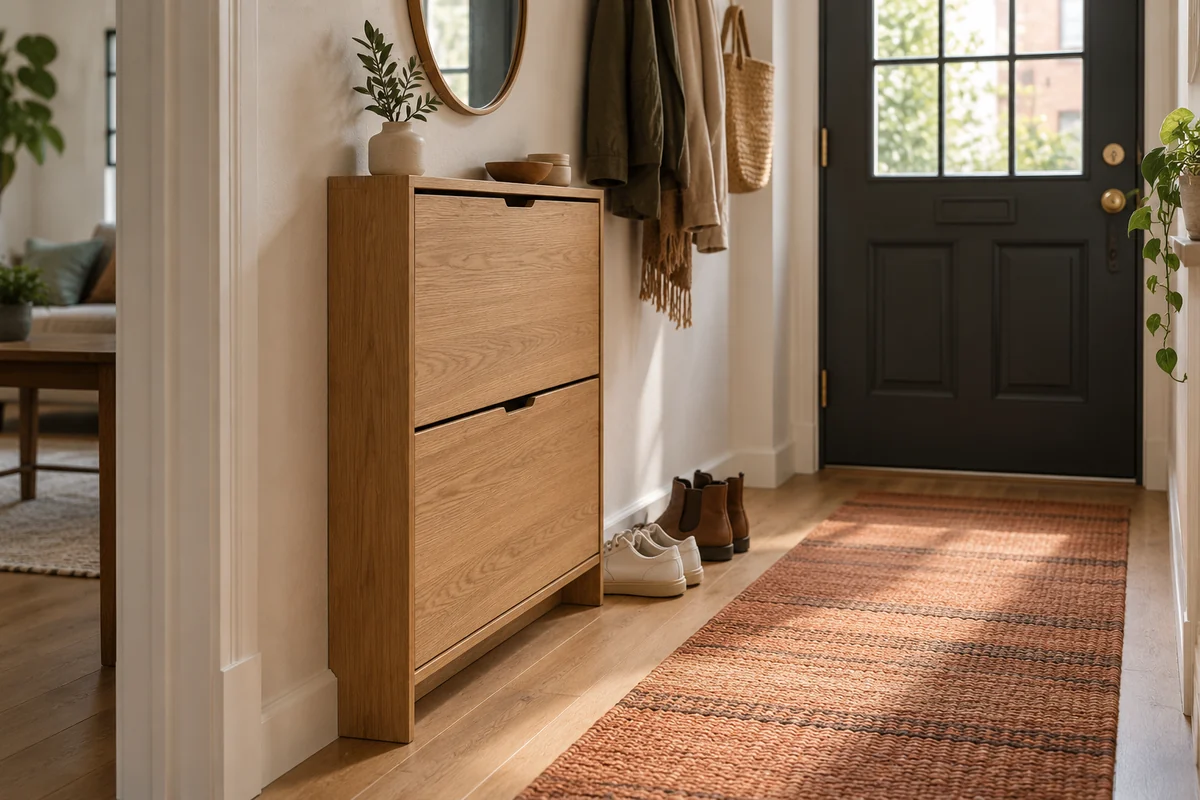
The best small shoe cabinet should improve the trip through your front door. A cabinet that hides the pile but forces you to turn sideways has solved only half the problem. Start with the shoes that need daily access, then decide whether your tightest limit is the wall's width, the walking route, or the space for opening a compartment. These documented options cover a shallow closed cabinet, a narrower closed cabinet, and a tiny open rack for readers who do not need doors.
The quick decision
Our picks, by the space you have
Start with HOMCOM when closed depth is the main constraint. Consider BISSA when the available wall is short. Choose the Yamazaki rack alternative for a small visible rotation rather than a concealed collection. These are use-based shortlists, not a ranking from hands-on testing.
These selections compare manufacturer documentation, not hands-on testing. Confirm the exact version, dimensions, instructions, seller, availability, and returns. We cannot verify fit or durability in your home. Illustration photos show room ideas, not exact reviewed products. “Best” refers to the use cases within this shortlist, rather than a market-wide ranking. Research checked October 18, 2026.
Compare the models at a glance
Product dimensions exclude operating clearances. Dimensions are in inches; W = width, D = depth, H = height, L = length. Unlabeled brand dimensions are kept in their published order.
| Model | Size | Format | Best fit | Current offer |
|---|---|---|---|---|
| HOMCOM 837-142, white | 30 W × 7.5 D × 46 H in | Up to 12 pairs; maximum US men's size 10 | For a shallow closed cabinet | Search Amazon |
| IKEA BISSA 105.302.59 | 19¼ W × 11 D × 53⅛ H in | Three compartments; up to 12 pairs | For a short stretch of wall | Search Amazon |
| Yamazaki Tower Tall 2478 | 8.66 W × 7.09 D × 30.51 H in; manufacturer text specifications | Five pairs; 2.2 lb per tier | Open-rack alternative for a tiny corner | Search Amazon |
Retailer links open a new tab. Search links are labeled “Search Amazon”; match the full model number. Check current price, availability, seller, and returns on the retailer page.
The shortlist
Why these small products make the list
For a shallow closed cabinet
HOMCOM 837-142, white
30 W × 7.5 D × 46 H in · Up to 12 pairs; maximum US men's size 10
Three flip drawers conceal everyday shoes while keeping the closed cabinet shallow. This is a useful candidate when a hallway has enough wall width but little spare walking depth. The linked manufacturer listing describes the white 837-142 version.
Allow extra space to open each drawer and stand in front. Assembly and anti-toppling attachment are part of the setup. The stated shoe-size limit matters more than the pair count for larger footwear.
For a short stretch of wall
IKEA BISSA 105.302.59
19¼ W × 11 D × 53⅛ H in · Three compartments; up to 12 pairs
The three-compartment BISSA uses less wall width than the HOMCOM. Adjustable or removable dividers let you arrange the compartments around your collection, and a rear cutout accommodates a baseboard. IKEA's own listing is linked for specifications and direct shopping.
The narrower cabinet is deeper and taller. It must be fastened to the wall, and shoe shapes affect usable capacity. An Amazon search may include resellers or different versions; compare the exact article number with the IKEA page.
Open-rack alternative for a tiny corner
Yamazaki Tower Tall 2478
8.66 W × 7.09 D × 30.51 H in; manufacturer text specifications · Five pairs; 2.2 lb per tier
This open steel tower gives a small everyday rotation a vertical home without using a cabinet-width wall. A top handle helps reposition it. It is an alternative when quick access matters more than hiding shoes behind a door.
This is a rack, not an enclosed cabinet. Shelf heights are fixed, and the manufacturer FAQ recommends shoes up to men's size 10. The page's dimension illustration differs slightly from its text; leave fitting tolerance and confirm a critical measurement before ordering.
Count the everyday rotation first
Put the pairs used every week together before choosing a capacity. Shoes kept for a different season can live elsewhere, leaving the entryway responsible for a manageable rotation. Separate tall boots, bulky trainers, and delicate pairs that need special handling. A cabinet's advertised pair count assumes footwear fits the internal arrangement; it is not a guarantee for every mix.
Measure the hallway with the cabinet in use
Tape the closed footprint on the floor, then imagine pulling a drawer out while someone enters carrying groceries. Include the front door swing, nearby closet doors, and your standing position. Measure at baseboard level and above it, because the wall face and the usable floor boundary may differ. Leave tolerance around furniture rather than treating rounded exterior dimensions as a promise of a tight fit.
Decide whether concealment earns its space
Doors can make a mixed collection look calmer, while an open rack keeps shoes visible and easy to grab. Neither format is automatically right for a small apartment. If everyone removes shoes in a hurry, a simple open landing place may be easier to maintain than several compartments. If the entryway is visible from the living room, enclosed storage may be worth the extra width and the opening motion. Choose around the household's actual habits.
Check the wall and the exact version
Read the installation instructions before selecting a final position, including the cabinet's attachment requirements. Check for obstacles where fittings will go and obtain hardware appropriate to the wall. At checkout, compare the model or IKEA article number, color, and number of compartments with the source linked in the pick. A similar photograph can describe a deeper cabinet or another size. Keep the documentation available for assembly and for a future move.
Before you choose
Common questions
Will a twelve-pair cabinet hold twelve pairs of large trainers?
Do not assume so. Pair counts depend on shoe shape and the internal arrangement. The HOMCOM listed here specifies a maximum US men's size 10. Measure a representative bulky pair and check the exact cabinet instructions before treating capacity as a purchase requirement.
Is the Yamazaki option a shoe cabinet?
No. It is an open steel rack included as an alternative for a very small shoe rotation. Choose a closed option when hiding the shoes is essential, and check the rack's fixed tier spacing if you want to store anything taller than everyday shoes.
Sources and how we chose
We compared the exact models below using their brand specifications and setup information. Recommendations reflect our interpretation of those documents for small-space use. They do not represent hands-on testing, customer ratings, or a measured performance ranking.
- HOMCOM 837-142, white: manufacturer specifications and support
- IKEA BISSA 105.302.59: manufacturer specifications and support
- Yamazaki Tower Tall 2478: manufacturer specifications and support
We omit live prices because offers change. No star ratings or review scores have been assigned. Read our full methodology.
Make the shortlist fit your room.
Measure the usable space, then add doors, drawers, hoses, and ventilation from the exact manual.
Open the fit check →