
The cabinet fitting between two walls is only the first sizing test. You also need operating clearance, a path into the room, and a realistic idea of what each load can hold.
The quick answer: Keep cabinet size and laundry capacity in separate columns. A small exterior measurement does not establish which bulky items the drum can handle.
Plan these three things first.
Record usable width, depth, and height.
02Measure the path, tooA machine that fits the final corner may not fit through the doorway, hallway turn, elevator, or storage opening.
03Treat load examples as approximateCubic-foot and weight claims are not interchangeable across products.
Measure the full envelope
Record usable width, depth, and height. Then account for lid or door movement, hoses behind the appliance, faucet reach, airflow clearance, leveling, and the space needed to load and unload safely.
Measure the path, too
A machine that fits the final corner may not fit through the doorway, hallway turn, elevator, or storage opening. Record the narrowest point and include handles, packaging, and safe carrying clearance.
Treat load examples as approximate
Cubic-foot and weight claims are not interchangeable across products. Fabric type, item bulk, balance, and manufacturer loading instructions change what is practical. Bedding is a much harder requirement than everyday clothing.
Leave operating clearance
Published cabinet dimensions do not include every movement and connection. Add room for the lid to open, hoses to bend without kinking, the faucet connection to sit naturally, and your body to load the tub. If the washer will roll into storage, measure both its working position and its storage position.
Translate capacity into frequency
A smaller tub can work well when loads are frequent and predictable. A larger tub may reduce the number of cycles, but it takes more floor space and is heavier to move. Instead of chasing the largest number, estimate how many everyday outfits, towels, and sheets you need to wash between laundry days and choose the smallest model that can handle that routine comfortably.
Make the decision concrete
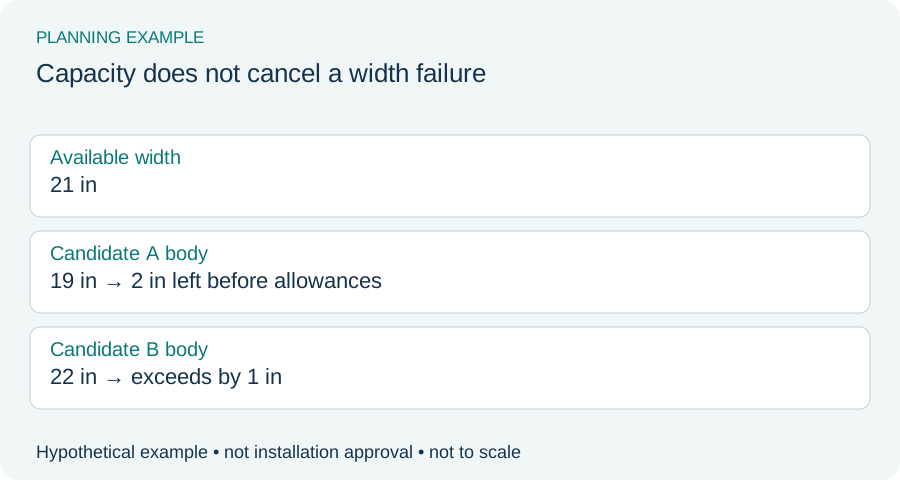
Example: capacity does not cancel a width failure
Hypothetical candidates: A is 19 inches wide; B is 22 inches wide. Your measured opening is 21 inches. A leaves 2 inches before additional requirements, while B exceeds the opening by 1 inch. If A cannot handle your bedding according to its manual, retain an off-site bedding routine or choose another location rather than buying B because its tub is larger.
| Check | Record | Watch for |
|---|---|---|
| Cabinet | Outside dimensions including fixed projections | Capacity used as a size proxy |
| Operating envelope | Lid, connections and manufacturer allowances | Unspecified gaps assumed zero |
| Laundry load | Bulk and load instructions for exact model | Pounds converted directly into cubic feet |
Try your measurements
Check one dimension at a time
Use the same direction for all three inputs: width, depth or height. Add all required extra space on that axis, including movement and manufacturer clearance. Repeat for the other axes and check obstructions separately.
Enter all three measurements. Leave required extra space blank if it is unknown; do not assume zero.
Available space − product body − required extra space = space remaining
See the measurements
Real products to compare with your space
These examples make the size tradeoffs easier to see. Open a product page for the complete fit verdict, setup notes, and retailer options.

BLACK+DECKER BPWM09W
One person, very tight spaces, and small loads washed often
View fit detailsHamilton Beach HBPW160
A balanced capacity for one or two people without full-size hookups
View fit detailsCOMFEE' CLV16N2AMG
Apartment shoppers who value simple controls and wheels
View fit detailsDo this before placing the order.
- Measure the destination. Include the full usable width, depth, height, and every fixed obstruction.
- Measure the working position. Add door, lid, hose, ventilation, loading, and walking clearance.
- Measure the route. Check doors, halls, stairs, elevators, corners, and the storage opening.
- Verify the exact model. Compare the manufacturer documentation with the listing before buying.
What this guide cannot decide
Room measurements cannot prove that a particular comforter or laundry weight is safe for a specific machine.