
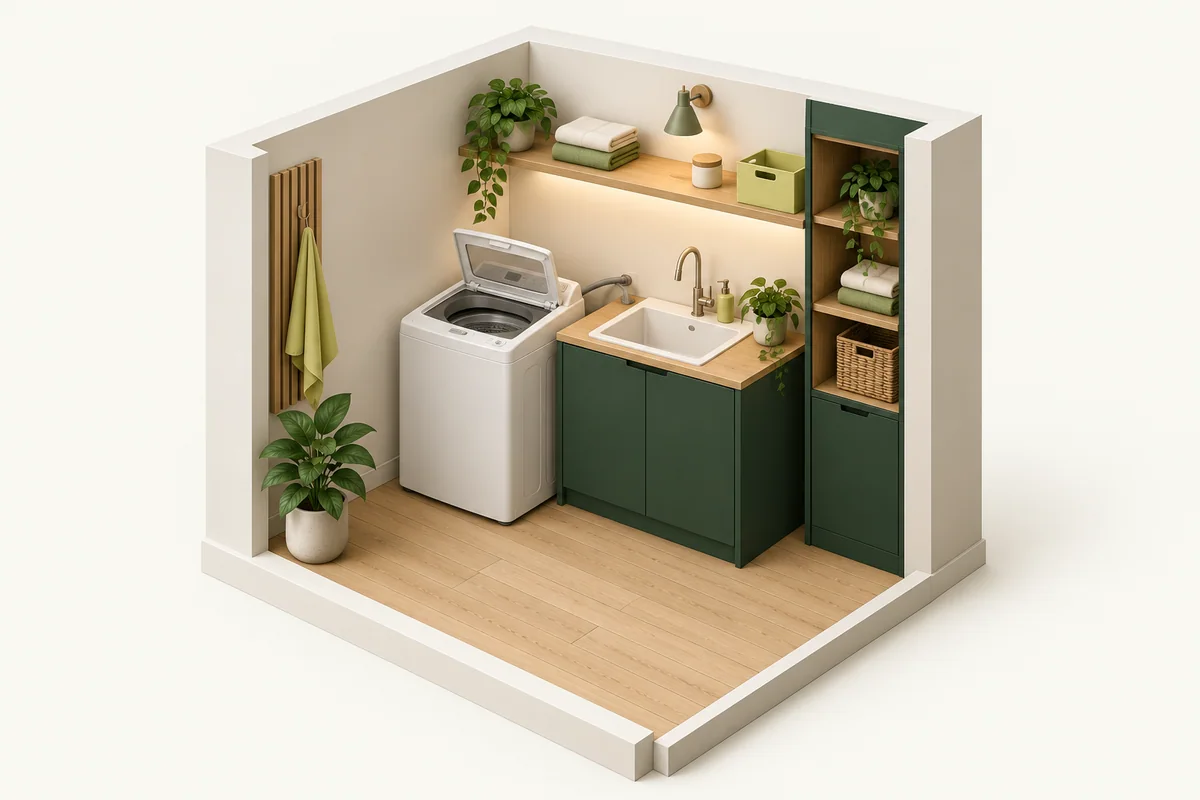
Filling a portable washer gets most of the attention, but draining is where a loose hose, slow fixture, or unstable container can turn a normal cycle into water damage.
The quick answer: Compare the actual drain route with the exact manual: discharge method, outlet height, hose configuration and a suitable receiving fixture all matter.
Plan these three things first.
Confirm whether the model uses a pump or gravity drain and follow its required hose height and routing.
02Evaluate the receiving drainA sink, tub, or standpipe must accept water at the rate the machine releases it.
03Secure the hoseUse the supplied guide or manufacturer-approved method so the hose cannot jump free when the pump starts.
Know how the machine discharges
Confirm whether the model uses a pump or gravity drain and follow its required hose height and routing. A pumped discharge can move water quickly; a gravity system may depend heavily on placement. Do not change the hose diameter, extend it indefinitely, or raise it outside the manufacturer limits without documented approval.
Evaluate the receiving drain
A sink, tub, or standpipe must accept water at the rate the machine releases it. Slow drains, stoppers, strainers, dishes, or existing clogs can cause a backup. Run and observe the fixture before the first laundry cycle, but remember that a faucet flow test may not reproduce the washer's discharge rate.
Secure the hose
Use the supplied guide or manufacturer-approved method so the hose cannot jump free when the pump starts. Avoid a route where someone can bump the hose or close a door on it. The outlet should remain visible during early loads, and the hose should not be submerged in a way that creates an unsupported siphon or backflow risk.
Plan for failure
Know how to pause the machine and shut off the water. Keep the floor clear, inspect connections, and consider a water alarm as an additional warning. Never rely on a small bucket unless the manufacturer documents that method and the container can safely hold the full possible discharge.
Recheck the route every load
Portable setups are connected, moved, and stored repeatedly, so yesterday's safe position may not be today's. Look for cracks, flattened sections, loose clamps, and shifted hose guides. Supervise the cycle and stop when drainage sounds different, slows unexpectedly, or appears near the edge of the receiving fixture.
Make the decision concrete
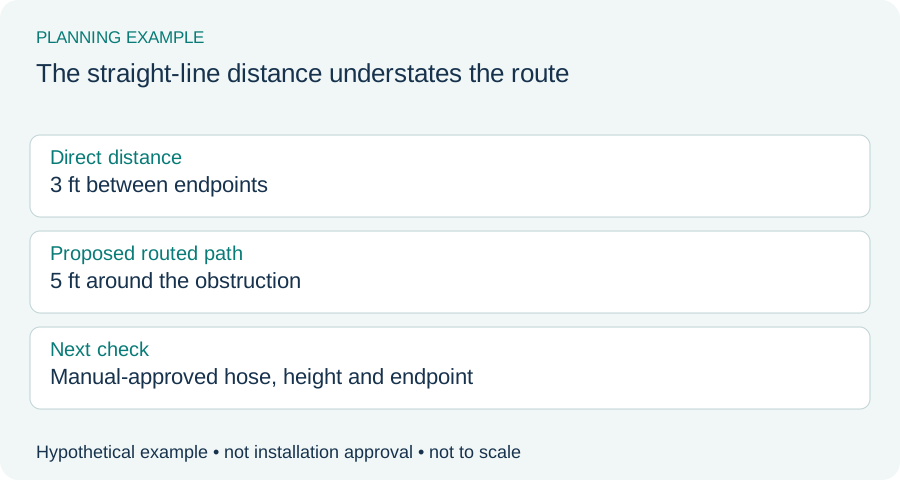
Example: the straight-line distance understates the route
Hypothetical planning sketch: the sink is 3 feet from the washer in a straight line, but routing around a cabinet makes the proposed path 5 feet. If the supplied hose cannot cover that permitted route, do not improvise an extension. Ask the manufacturer about an approved arrangement or move the washer. Length alone never establishes correct outlet height or a suitable drain.
| Check | Record | Watch for |
|---|---|---|
| Discharge | Pump or gravity method in the manual | Assuming every washer pumps uphill |
| Route | Full path, allowed heights and bends | Straight-line distance used as hose route |
| Endpoint | Approved fixture and secure positioning | Loose hose or uncertain collection vessel |
Try your measurements
Check one dimension at a time
Use the same direction for all three inputs: width, depth or height. Add all required extra space on that axis, including movement and manufacturer clearance. Repeat for the other axes and check obstructions separately.
Enter all three measurements. Leave required extra space blank if it is unknown; do not assume zero.
Available space − product body − required extra space = space remaining
See the measurements
Real products to compare with your space
These examples make the size tradeoffs easier to see. Open a product page for the complete fit verdict, setup notes, and retailer options.
BLACK+DECKER BPWM09W
One person, very tight spaces, and small loads washed often
View fit detailsHamilton Beach HBPW160
A balanced capacity for one or two people without full-size hookups
View fit detailsCOMFEE' CLV16N2AMG
Apartment shoppers who value simple controls and wheels
View fit detailsDo this before placing the order.
- Measure the destination. Include the full usable width, depth, height, and every fixed obstruction.
- Measure the working position. Add door, lid, hose, ventilation, loading, and walking clearance.
- Measure the route. Check doors, halls, stairs, elevators, corners, and the storage opening.
- Verify the exact model. Compare the manufacturer documentation with the listing before buying.
What this guide cannot decide
This guide cannot verify the capacity, condition, code compliance, or backflow protection of a particular building drain.